Some of you might remember the original purpose for this blog, and if you don't, well, that certainly seems reasonable. For those of you who don't, the original plan was to make this a forum for me to occasionally discuss sports while mostly keeping track of my travels as I seek out all the various and exciting sporting events this country has available at its professional ranks. Lately, however, it hasn't really been doing much of the latter, which, clearly is my fault.
In fact, the last time I posted a story about my trips -- aside from last month's visit to the Northwestern-Illinois game at Wrigley, was July 11th. Oops. I suppose I should post one of these more often than once every five months. After all, the idea, originally, was to do it every week. But that might have been shooting a little high.
Either way, I know you've all been experiencing a life that is, in general, severely lacking without these stories, so I've come to cure your ills. And while this story is still pretty rough, distended and doesn't quite come full circle in the conclusion like I'd like it to, but it is a totally awesome stadium, a vaguely interesting, and given that we're currently in the middle of the annual Jewish festival of lights, and that this story is excerpted from a chapter that is supposed to deal with my Judaism, it seemed reasonably prescient for you all to see at this time of year.
And so, without any further ado, I present to you my long, distended, and unlikely-to-be-read-in-its-entirety-by-anyone story of my trip earlier this year to see the Giants get absolutely waxed by the Indianapolis Colts.
Originally written September 28, 2010.
It was on a bus in a rest stop just outside the southern Israeli City of Eilat that Brian Garfinkel said something that let me know I wasn’t alone in my own insanity.
“I heard it through the grapevine that you have a short-term plan to see all the professional sports teams,” he said.
At the time I was in Israel on a program known as Birthright, which provided all North American Jews between the ages of 18 and 26 a free ten-day trip to Israel, the purpose of which was to show you the wonder, imbue you with a stronger connection to your faith and heritage and in extreme cases, encourage you to move to Israel, marry Jewish and repopulate the Holy Land. At the time I had no intentions of moving to Israel, nor was I particularly religious. Frankly, those are still true. My only real purpose for going on the trip was because it was a free international vacation with the reputation of being summer camp with sex and alcohol.
In some respects it was exactly that. And it was in no uncertain terms an amazing experience.
But my Judaism was never really my defining characteristic before nor after. In many regards, my religion was something of which I felt very strong ethnically, but ambivalent towards theologically. It was a connection to my family, my culture, my history, and as a result it was always my preference to raise my children under the same principles, even if I never became a rabbi like some suggested only half-jokingly after my Bar Mitzvah. This trip would change those preferences slightly. I was never going to move to Israel, although I wouldn’t mind living in a country so fascinating, so beautiful and with such proximity to the rugelach sold at Marzipan Bakery in Jerusalem. But I did see a heightened importance in my own mind for raising my children Jewish as a necessity rather than a preference. Whether they believed in a God was their position to figure out on their own, but they will read from the Torah and they will listen to their parents complain at every High Holy Day, as is the tradition.
What I hadn’t anticipated was that the trip would give me new partners in crime as I cavorted around the country watching sporting events, but at the very least, it seemed I had one man, Brian, who wanted in. While Brian and I have many plans yet to come to fruition, the fortunate thing about this trip was that he wasn’t the only person who expressed interest in tagging along for a few stops on the journey. As it so happened, Dov Turner, a native of Kansas City cum resident of Chicago was also intrigued by the idea – or at least easy going enough not to reject the suggestion. Dov and I made a racket during the trip of calling the only two-person room for males at each stop so we wouldn’t have to share a bathroom with too many people. And from that strong foundation grew a promising friendship. A few weeks after returning to the U.S., the NFL released the Giants’ 2010 schedule and one particular game stuck out at me. In week two, the Giants would visit the Colts in Indianapolis for the second ever Manning Bowl. Two teams with high aspirations and Super Bowl MVP-winning quarterbacks who just happened to be brothers of the NFL’s Royal quarterback family would be taking the field. I decided I had to be there, and Dov was nice enough to oblige in joining in with me.
As it just so happened, the Giants’ season opener would be but a few days after Rosh Hashanah, which that year fell on the NFL’s traditional Thursday night kickoff game to be hosted by the defending champions; in this case that would be the New Orleans Saints. My trip to Indianapolis to meet Dov and see the Colts would come 24 hours after breaking my fast on Yom Kippur. The start of the new year would bring with it the start of a new season. L’shana Tova to football fans everywhere.
It seems fairly likely that I will always associate my trip to Indianapolis with Yom Kippur, the one Jewish holiday I actually take relatively seriously. In fact, when I had realized when Yom Kippur fell in 2010, which was after I had bought my plane tickets and game tickets, I was relieved to see that I did not actually schedule the trip for the Day of Atonement. Had I done so, I probably wouldn’t have taken it.
At this stage of my life, I’ve fallen out of the habit of attending services, but I still refrain from food or drink from sundown til as long as I can last the next day. Sometimes this is all the way until sundown and other times I tap out around 4:30 or 5 pm. In recent years, I’ve had more difficulty maintaining the fast because Grandma Barbara now hosts an annual catered feast to celebrate the end of the holiday and everyone’s clean slate. This typically includes a wide schmorgasboard of items ranging from potato salads to regular salads to lox, salmon, white fish, salami, roast beef, bagels, rye bread and a host of other items provided in quantities that could feed well more than the average attendance requires. Usually this is a blessing for my brother and I. Elliott and I have made a habit of collecting leftover cold cuts and making sandwiches with them for days after for several years now. One Yom Kippur saw us chowing down on enormous salami and roast beef sandwiches the next morning as we got together to see the positively silly and yet epic action film Shoot ‘Em Up with Clive Owen and Paul Giamatti.
This year I took a large sampling of roast beef for my early morning flight to Indianapolis some 12 hours later. I awoke at 7:30 a.m. that Sunday, September 19, 2010, and headed for the Seven train for what I expected to be a fairly routine trip to LaGuardia Airport. Dov and I had already spoken about our plans and after I arrived in Indy around noon and picked up my rental car we had a number of potential plans in place: a tour of the Indianapolis Motor Speedway, the NCAA’s Hall of Champions, dinner with my senior-year apartment mate, Pat Dorsey, and, of course, the main event – Giants-Colts at Lucas Oil Stadium.
As I sat on the subway and then waited for the Q33 bus, I didn’t think much of the wait, though I noticed I was going to be cutting it a little close for my 9:41 departure. I wasn’t checking any luggage since the trip was going to be a grand total of 20 hours, so I assumed I would be fine, but I arrived at the airport to experience a stunning surprise. Regardless of checked bags, Air Tran Airways required you to check in to your flight at least 30 minutes prior to take off. This bit of noteworthy information was nowhere to be found on my ticket, and so I, unaware, arrived at the check-in counter 23 minutes before takeoff and was not allowed to board. I was told I would be put on the next flight, but that wouldn’t be leaving for seven hours, and it would touch down at 7:12 p.m., barely an hour before kickoff. My plans were ruined, my day was shot, and my on-time arrival at the whole purpose of the trip was severely in jeopardy.
I used to be prone to massive explosions of frustration, but in recent years I have made a concerted effort to relax, take the long view and keep my head cool in nearly all situations.
This time I failed.
What proceeded was a massive temper tantrum where I pulled off the balancing act of yelling at the flight representatives and apologizing to them for my behavior all at the same time. Next came a long expletive-filled rant on the phone with my mother and father, both of whom gave me suggestions for how to try and get on an earlier flight with a different airline. I went back and forth to several terminals to see where I could find a seat and found that none were available beneath the rather steep price of $440. One was $1,100. Why an airline would raise prices and prevent a seat from being filled in the final hour before a plane departs is beyond me. In essence they could have $100 instead of none should the seat stay empty.
But no matter.
I was stuck at LaGuardia for seven hours until my 5 o’clock Indy-bound flight took off and that was that. For the next hour or so I ran through all the morning’s events in my head, taking particular note of anything unnecessary I had done or any act of random chance that could have shaved off the seven minutes I needed to make it on time. The subway train hadn’t arrived for four minutes when I got to the platform. The Q33 bus didn’t leave 74th St and Broadway for 10 minutes. I took a wholly unneeded shower when I woke up. I finished packing my bags after the shower with the few last items I would need. I made a sandwich from my grandmother’s Yom Kippur leftovers. I actually took the time to make a sandwich.
I MADE A SANDWICH.
Why on Earth did I decide to make a fucking sandwich?!
If I hadn’t atoned properly during Yom Kippur it seemed like I was going to spend the next seven hours doing my penance. Oh well. Lesson learned for next time, I suppose. After getting some of the anger out of my system by stomping around LaGuardia’s Central Terminal a few times, I walked through security when the first man to check my ID greeted me.
“How are you doing?” he said.
“Terrible.”
After noticing my Giants jersey and my destination, the security personnel put together that I was going to the game that night, and while he knew I would have little time to spare before game time, he reassured me, “At least the Giants will win. Then we’ll both be happy.”
This seemed like little consolation for my entire touristy day in Indianapolis being gone, particularly since I wasn’t expecting a victory. Aside from being, well, better than the Giants are, the Colts had lost their season opener in Houston in a reasonably-sized upset despite how competitive the Texans were expected to be this year. I could not fathom the horseshoes starting the season 0-2. To put in perspective just how good and well-rounded the Colts were, the season before my visit they won their first 14 games before handing the last two over in a highly controversial move to rest their starters. After a brief scare in the first half of the AFC Championship game against the upstart Jets, the Colts danced into Super Bowl XLIV where they lost a much tighter game than the 31-17 final score would indicate. Were it not for a surprise onside kick by New Orleans to start the second half, or one or two other minor incidents in the fourth quarter, Indianapolis might have had its second title in four years. To put it simply, a year earlier the Colts had lost only one game in which they actually tried to win – the biggest one of the season. Losing the season opener a year later was a dramatic shock to the system that Indy was unlikely to leave unanswered.
Knowing that and anticipating the loss, I was in the trip entirely for the purposes of seeing the city and checking out what was supposed to be a gorgeous stadium. Most of that was now gone, but I used my time wisely. I called the Indianapolis Enterprise Rent-A-Car to arrange to have my contract drawn up in hopes of expediting the trip from my plane to my car. If that morning taught me nothing, it was that every moment was precious.
In addition, I found that Kyle Peter, he of the Lambeau Field jaunt in 2006 and a venture to Turner Field in Atlanta four months earlier was flying out of LaGuardia at 5:45 and, as luck would have it, departing from the gate right next to mine. I knew Kyle was in New York that weekend, but we had been unable to meet up. By a random twist of fate, we would be spending the afternoon in the airport together, and fortunately the terminal’s sports bar provided enough football games to distract me from my bungled itinerary. Kyle arrived, we watched a few games, caught up and generally had a good time. If my day was mostly ruined I was going to be making the best of it.
Eventually, I boarded my plane and settled in for what was a relatively smooth flight. I wound up sitting next to a 31-year-old woman who taught Spanish in the Indianapolis public schools. She was nice, slightly high strung, conservative and had an adorable Midwest/southern hybrid accent. But she was also jarringly loud. Throughout most of our conversation I tried to speak in hushed tones hoping she would follow suit and spare the passengers around us who might have been napping, but that was a futile battle. During her weekend in New York, she and her twin sister did a Sex and the City-themed tour that provided them with overpriced cosmopolitans and her first-ever visit to a porn shop. If a relatively liberal, easy-going person like me finds those places overwhelming, I can’t imagine how she handled it.
As soon as the plane touched down, I bolted out of my seat and made my way towards the front of the plane so I could sprint through the airport and get to my car quickly. Locals reassured me I had plenty of time to get to the stadium, but with the minutes ticking away I wouldn’t be calm until Dov and I were in our seats at kickoff. I jetted through the concourse until I reached the Enterprise lot where, sure enough, a man was waiting for me with a set of keys and a clipboard. I signed and he told me to enjoy the game, at which point I said to him, “That all depends on the Giants.”
“Well,” he replied, “in that case, I hope you don’t enjoy it too much.”
As I coordinated with Dov, who had spent the afternoon checking out museums and drinking copiously, I sped down I-70 East in my bright yellow economy car, which amazingly did not have power locks, only to find I was, in fact, going to be fine. The drive from the airport to Lucas Oil Stadium was t most 10 minutes. Maybe it would get stretched to 12 with traffic. One thing they could stand to have, however, are some better highway signs. There was almost no mention of the stadium, which caused me to miss my first chance to turn off and pull into a lot. When I finally got off the highway and navigated the crush of marching blue-clad Colts fans, I waved to a policeman who was standing at the corner and asked him where there was parking.
The cop told me he couldn’t hear me and walked over. He wore a large park ranger hat, opaque reflecting sunglasses and had a big bushy mustache. He looked exactly how you would expect a grizzled southern sheriff to look. When he arrived he gruffly said, “Next time, you walk over to me.” I was a bit anxious at this point until he cracked a smile to show that he had been joking around. After easing the tension he directed me to an official lot that was $30 or a highly unofficial one across the street which was $20. After driving by the $20 lot the man waving cars in told me I could park for just $15. Given that no one was wearing anything even closely resembling an official uniform and that the four employees had about seven teeth between them, it was obvious that this wasn’t your classiest parking lot – though I did enjoy the blue school bus with tailgating fans that had “Department of Erection” painted on the side. I gave the attendant a $20 bill and waited for my change, at which point he fumbled through his pockets aimlessly and was somehow unable to find the $5 in change I was owed.
The man was a terrible actor.
Given how relieved I was to simply be at the stadium with time to spare, I decided to forgo the $5 and walk over. On my way I was asked to donate money to breast cancer research by a group of girls who couldn’t possibly have been any older than 18 or 19. I gave them a few dollars and one of them said to me, “Honestly, how can you turn down a campaign called ‘Save the Boobs’?” I decided that given how much younger they were it was in my best interest not to continue that line of conversation, and I moved on to find Dov at the north end of the stadium under a glitzy Vegas-esque lighted sign that read “COLTS” outside the team pro shop.
Ironically, the first thing Dov said to me was, “Is it just me or are the breasts …. larger in this part of the country?”
After everything, Dov and I wound up together at the stadium with nearly a half hour to spare before kickoff. I had arrived, safe and sound, tickets in hand, all was well. Lucas Oil Stadium is a tremendous, tremendous facility. Because of the uniformity of a football stadium, making it architecturally interesting is a challenge in and of itself. What had brought the craze of stadium building back to life in baseball was the retro themes inherent in Camden Yards. Football stadiums for the decade of the 1990s stayed behind that trend. In the late 1990s stadiums began to seize on the retro feel, adding red brick to the design of their exteriors, but Lucas Oil Stadium brings these efforts to a new level, and to me, feels like the quintessential answer to baseball’s retro romance.
Lucas Oil has a completely enclosed, brick and steel façade that gives it an appearance similar to other sporting venues around the city, and one that brings to mind an old classic warehouse or an airplane hangar. The exterior is so aesthetically pleasing you almost forget you’re about to walk into a stadium with a roof. Fortunately, the roof is retractable and that night it was open, which made the experience all the more enjoyable. The entrances, it should be noted, are all heavily decorated with a specific sponsors’ services in mind, which comes off as a bit hokey, but at our gate this involved a gigantic Colts helmet hanging from the ceiling with a face mask made of HDTVs. At the very least, the advertisements seemed contained within the Colts’ theme. The north end of the building features a large glass window that provides views of downtown and allows natural light to pour into the stadium even if the roof is closed. The concourses are wide and spacious – they even have gigantic ceiling fans to keep customers cool – the Colts’ presence is enhanced by the speed blue colored seats and all of the sightlines, even if you’re in the far reaches of the upper deck like we were, are tremendous.
Oh, and it’s loud.
For a stadium that is open and holds only 63,000 people – a relatively small capacity by NFL standards – it is shockingly loud. If anyone ever thought to question how rabid a fanbase Indianapolis might have, one trip there will dispel that notion. The residents are passionate, obsessed and quite possibly possessed.
And sweet lord they are loud.
As the Giants took the ball for their first drive I couldn’t hear myself think, which makes me wonder how on Earth any of New York’s linemen could possibly have heard Eli Manning. My head actually started to hurt and one friend sent me a text message to inquire as to whether it was actually as loud as it seemed on TV. I told him it was louder. Dov meanwhile, was fielding texts from his girlfriend who intimated that she might actually watch the game on TV in hopes of seeing him. He told her he’d be the one in blue.
The one drawback I can find is the Colts seemingly hang a banner for anything. That night they lifted a banner for their 2009 AFC Championship to the rafters, a deserved achievement. But in addition to Conference titles and division championships, others touted Wild Card playoff berths and the presumed title of “AFC Finalist” from their unlikely run to the AFC Championship Game in 1995. For a stadium that is, in so many other respects, so well done, these dramatic grabs at pieces of history seemed hacky. I was half surprised not to see a banner touting Peyton Manning by calling the Colts “1998 NFL Draft No. 1 Pick Champions”. Perhaps more interesting is there seems to be nothing in the stadium about the team’s history in Baltimore, which may be appropriate considering Johnny Unitas asked them to unretired his number because he never played in Indianapolis. The closest link to their Baltimore past is that former owner Robert Irsay is in the stadium’s ring of honor, though to anyone with a sense of NFL history, this seems a bit controversial. At least he’s also accompanied by Northwestern alum Chris Hinton.
If it seems like I’m almost ignoring the fact that there was also a game going on, it’s because a game typically requires both teams to be competitive to be considered “a game”. And this was not that. Indianapolis jumped out to a 24-0 halftime lead, outgained the Giants by 153 yards and took advantage of three New York turnovers in an eventual 38-14 romp. Peyton only threw one more touchdown pass than Eli, but the Colts solidly bested the Giants in just about every facet of the game. The only aspect New York might have had an advantage in would have come if a spontaneous discus competition broke out, which is what I assume running back Brandon Jacobs was practicing for when he accidentally tossed his helmet into the stands, a move that cost him $10,000 in fines.
The best part of the game itself was that my needed bathroom break in the first half came just as the Giants made a coaches challenge so I would miss nothing. Considering what transpired on the field, however, that was probably a bad thing. At least my pulled pork sandwich was good even if it immediately gave me more to atone for next year.
While the Giants gave me little to cheer, I at least enjoyed the halftime presentation when the Colts trotted out the 2010 Butler University Men’s Basketball team, which had pulled the city, and most of the country, behind it with a dream run through the 2010 NCAA Tournament months earlier, that came to an end when a last-second halfcourt shot by Gordon Hayward just clanged off the rim in the title game against Duke. While I had rooted for them in March, my favorite part of the Bulldogs’ ovation was that the video introduction actually included scenes from Hoosiers, which made it almost too ridiculous to be real. It was a far more tasteful video montage when compared with a bizarre sequence in the second half in which the Colts’ mascots were on the video screen performing very sexually suggestive dance moves. This was particularly odd considering team owner Jim Irsay is well known for his strong religious and family values.
After the disastrous exercise on the field came to a close, Dov and I sat in our seats and waited for the stadium to filter out so we could take a few more pictures of the place when it was empty, which enabled you to see hidden goodies like the Colts logo in the seats of the upper deck. I realized at this point that Dov was an extremely pleasant person to see a game with. He’s easy going, he doesn’t mind arriving early, he stays til the end even if it’s a blowout and he doesn’t care about looking like a tourist when taking an endless stream of photographs. And perhaps most importantly, he was willing to travel by himself to a sporting event that he had absolutely no vested interest in whatsoever. As a result, it probably won’t be the last time I invite him to tag along.
I guess something meaningful, impactful and lasting actually came out of that trip to Israel.
Dov and I found the car miraculously sitting safe and sound. As we drove ever so slowly through the traffic we only became more and more aware with how much people love the Colts. My favorite group was easily the bus next to me filled with drinking and dancing Colts fans as well as a disco ball. Eventually we reached our very low quality hotel where we would be spending a grand total of seven hours. Most of that wasn’t spent sleeping, which is just as well because we hadn’t gotten a great deal of time to just catch up with my travel plans going out the window. Much of the conversation revolved around how dirty the hotel was, particularly our bedroom window which was so covered with dirt it was nearly opaque. The room nearly ousted the Econo Lodge in St. Louis five years earlier as the dirtiest I had ever stayed in.
I shouldn’t bash it too much, probably because I didn’t get to try out the “gym”, which was one windowless room with a treadmill, but at least there was a continental breakfast of instant orange juice, biscuits and gravy. We left the hotel after a nap and headed to the airport and found the bleak early-morning light made the area look about how you’d expect a barren field in Indiana to look.
As I waited in the gate area I looked around at the rest of the passengers, all of whom appeared to be depressed Giants fans, who looked like they had just been beaten like they stole something. Perhaps they all ate on Yom Kippur, and the previous night’s whipping was punishment for ignoring the holiest day on the calendar. That seems unlikely considering a number of them were almost certainly not Jewish. Next time I see the Giants on the road, maybe they’ll win and we’ll all leave a little happier.
Of course, we should take it one step at a time. I should probably just focus on waking up early enough to actually make my flight.
Showing posts with label Airport Security. Show all posts
Tuesday, December 7, 2010
Tuesday, February 16, 2010
But I’m a Good Drunk Driver
Originally written February 1, 2010.
Perhaps the most remarkable thing about Missouri is, at least as of 2008, it is one of just eight states in the union that allows passengers in a car to drink open alcohol. While I and my compatriots took advantage of this on the way to Kauffman Stadium on July 26, 2008, it became readily apparent to me that in a town where the communal ethos every Saturday night is “I know I’m driving home drunk, but I’m a good drunk driver,” as one Kansas City resident said to me, this is unbelievably stupid. In a state where three years earlier I had seen a sign reminding Cardinals fans that “Missouri law prohibits firearms in a sporting venue with a seating capacity of 5,000 or more,” this was far more disconcerting. Then again, in a city where bars in the Waldo neighborhood sell domestic bottles for $1.50, I can’t blame them for enjoying the revelry. What Lewis Black said of Madison, Wisconsin holds true in Kansas City, Missouri.
Even with the plane ticket it’s cheaper than drinking in New York.
Regardless, I wasn’t thinking of the theoretical implications, I was just enjoying drinking my Sierra Nevada. I always thought the idea of drinking openly and brazenly on the car ride to a baseball game was a little ridiculous, or at the very least required questionable judgment. But here I was, enjoying every minute of it. Not being quite sure what was proper and yet still relishing in it was probably the theme of that trip to Kansas City for me. In a city distinctly different from my own, the brief sojourn was a wholly educational experience.
I had come to Kansas City that summer to visit Susie Sharkey, whom I had met five years earlier while working at Fairview Lake YMCA Camp. Fairview generally hired a large swath of counselors from across the country and the world, prompting me to make friends with people as close as New Jersey and as far as Australia. Kansas City lay somewhere between those two on the exotic scale.
I’m not sure when the moment occurred that Susie and I became so close, though I theorize it was probably the night during staff training when we sang an impromptu rendition of Don McLean’s “American Pie”, likely to the chagrin of everyone around us. In the years since, Susie visited me in Chicago, I visited her while she was working in a Jesuit Social Work program in Sacramento, and she visited me in New York in April of 2008. If the pattern involved alternating, well, I suppose it was my turn again.
I bought a plane ticket with a few goals in mind, namely indulging in famed Kansas City BBQ, visiting the Negro Leagues Museum, stepping foot in the state of Kansas and, obviously, seeing a Royals game. Really, it was the barbecue that was key. This trip was far more organized than my trip to Sacramento two and a half years earlier, when a winter storm-induced airline snafu caused me to spend my first day in California as the designated driver for Susie’s roommates whom I had never met before while Susie, ironically, spent the night in Chicago.
This time she was at the airport waiting for me.
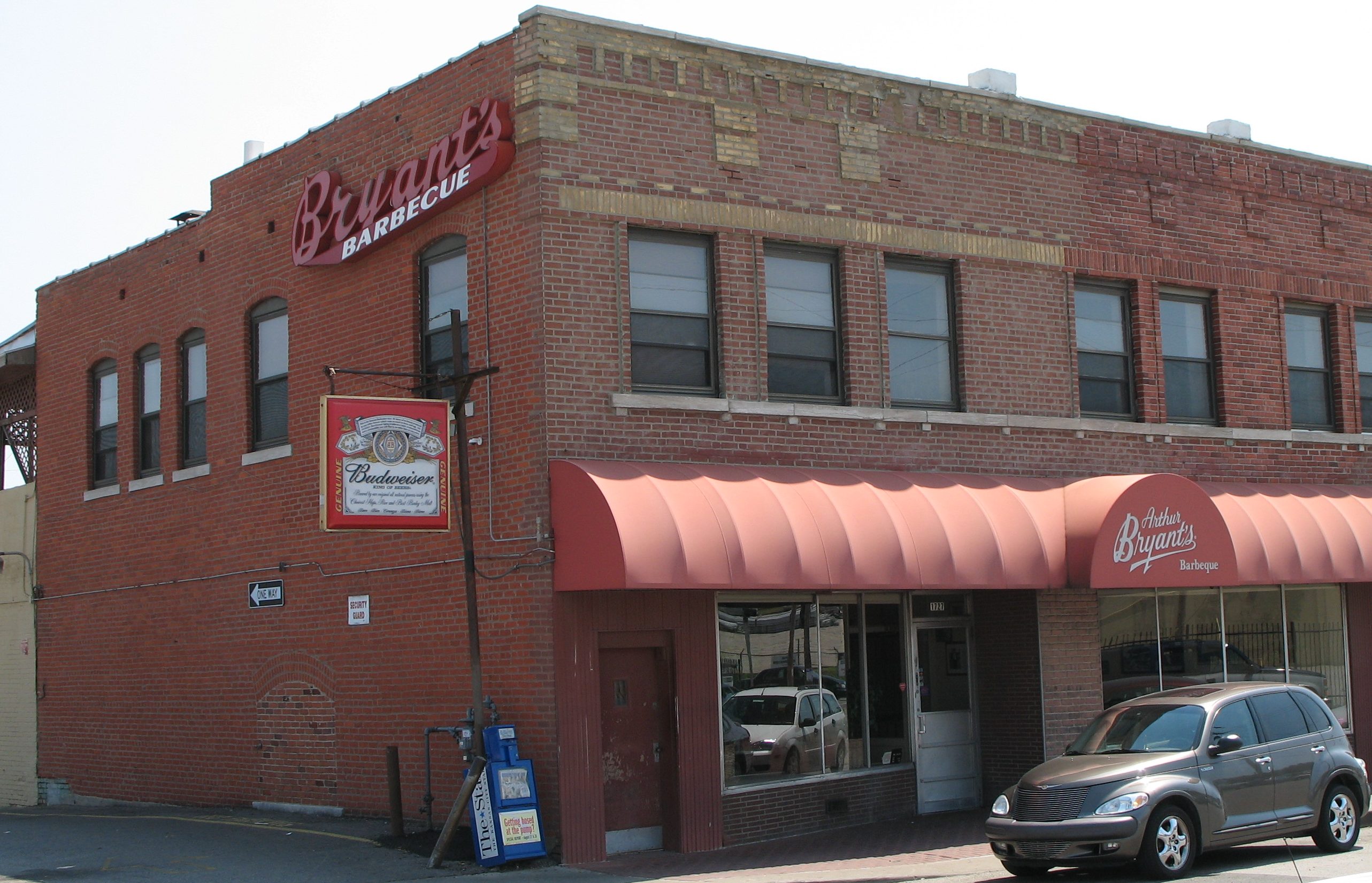
Apparently, I prepped Susie for my visit well, because she wasted little time in knocking off the first requirement, as she drove me, her friend Kathleen and her brother John directly from the airport to Arthur Bryant’s, considered by some to be the most famous barbecue restaurant in the world. While it has been patronized by all manner of celebrities – a few months after I visited GOP nominee John McCain and his running mate Sarah Palin would stop in – the décor is about as fancy as a high school dining hall.
When you eat there, however, you’re thankful that’s the case. Were they to fritter away money on repairing the chipped formica tables, it might distract them for the more pertinent task of preparing the food. I had the brisket and burnt ends, their specialty, and felt my arteries clogging almost immediately. This would be a trend for the entire weekend.
The next day Susie and I visited the Negro Leagues Baseball Museum, which is located in the same building as the American Jazz Museum and you can buy a joint entry into both of them. We did, but after the Negro Leagues Museum we were fairly wiped out. It contains a number of interesting pieces of memorabilia as well as early 20th century and late 19th century newspaper articles and posters that are riddled with hints of America’s racial tension. The one thing that struck me most, however, was that a number of the placards and exhibits were damaged or otherwise in disrepair. In most museums these things would have quickly been fixed, but much of the damage hadn’t been touched in years it seemed.
This didn’t show me so much that the museum was not well kept or curated – it was well organized and very interesting – but rather it gave you the feeling that it wasn’t fixed because people didn’t seem to care as much about this particular museum. Perhaps I’m reading too much into it, but torn plaques in exhibits would never fly at the Baseball Hall of Fame in Cooperstown, New York. But that, I feel, was long a white institution. Making sure that the dedication to African-American heritage in baseball history was just as pristine and professional just didn’t seem important to enough people, which is truly a shame. Neglecting greats like Satchel Paige, Josh Gibson and Cool Papa Bell is as tragic a situation for all of baseball as it is for black baseball. But in the racial wounds of this country, some of which will never heal, this one, I suppose, is fairly minor on the grand scale.
The barbecue tour was far from over, and Susie was as strong a partner as I could hope for. Our next stop was Oklahoma Joe’s, a slightly more well-kept, but equally as casual joint as Arthur Bryant’s that lies past a scenic drive of industrial factories at 3002 West 47th Avenue in Kansas City, KS. The line was long – it was the heart of lunch time – and the people behind the counter were good-natured and slopped an outrageous amount of food on your wax-paper covered trays. I went for the jumbo size pulled beef and pork sandwich with a side of French fries. It was probably enough calories to keep me running for a year or so.
After this, other highlights of the trip included a venture to Hallmark headquarters, an obligatory visit to Culver’s so I could get a double butter burger with cheese and frozen custard, and perhaps the most interesting, the Sprint Center in downtown KC. The thoroughly modern arena is a sharp building. Its outside is entirely made of glass and curves in a modern and tasteful fashion. The stadium is meant to be the anchor of the revitalized Power and Light District, which also has a number of apartments and restaurants, one of which, a location of the Famous Dave’s BBQ chain, was pointed out to me by Susie as a restaurant we would not be going to when there was authentic Kansas City BBQ to be had.
There is only one problem with the arena, and that is, well, no one plays there. It does regularly host concerts as well as college basketball tournaments – it is hardly vacant – but professional sports, aside from a few preseason games, have yet to make their presence felt there.
It is, however, home to the Collegiate Basketball Hall of Fame and the College Basketball Experience, which is completely awesome. Susie and I did our best to beat the buzzer with three-pointers and test our passing accuracy. Each activity has a sign explaining the museum’s rules which, adorably, include “absolutely no swearing or cursing.”
There I learned that Shaquille O’Neal, not surprisingly, has feet about twice the size of mine. Also, dunking is hard.
Really hard.
Visitors can test their skills dunking on hoops 7, 8, 9 and 10 feet high, and while, I have never been noted for my athletic prowess, I struggled with the shortest one. It was here that I came to the stunning conclusion that dunking a basketball is an obscenely difficult task. It is absurd that human beings can actually do it.
The last bit of the museum is a quiet hall denoting all the members of the college basketball Hall of Fame, which happens to be accompanied by softly playing college fight songs. I cracked a smile when “Go U Northwestern” started playing, though given NU’s inauspicious basketball history –it is the only school in the six major conferences never to make the NCAA Tournament – it seemed an odd choice. Then again, as a freshman I practiced with the Ultimate Frisbee team at Patten Gymnasium in Evanston, which hosted the first ever NCAA Tournament Championship Game in 1939. I struck up a conversation with an older man, a Michigan alum, while Susie watched on in amazement that I could reel off so much pointless sports trivia with a man three times my age. I wasn’t sure if I should be proud or seek to do more productive things with my time.
Other highlights of the weekend included a party at Susie’s house where I made sure to bring six packs both of Leinenkugel’s Sunset Wheat and Leinenkugel’s Summer Shandy, which I hid in the back of the fridge. About 10 beers later, and after generally making a fool of myself, it was time to slow down.
The next day was the main event, a Saturday night showdown at the K with Susie, her boyfriend Kevin and her friend Hennie. As the non-drivers among us sipped our beers on the car ride, we approached the stadium, which sits in a complex next to the Chiefs’ Arrowhead Stadium, and were informed by Hennie that her ex-boyfriend was apparently also attending. The potential for awkwardness abounded, but surely we wouldn’t bump into him in a stadium that held more than 38,000 people.
The odds were that we wouldn’t even see him, let alone park just a few spots away from him in the stadium lot. Ah, but the odds are odds and not certainties for a reason. Sure enough there he was, and the uncomfortable hello conversation ensued. I’m fairly convinced in the years since that this was the moment Hennie decided she no longer wanted to be at the game. I can’t say I blame her – I would probably feel uncomfortable in the same position, but having come halfway across the country to see this baseball game, I was less than sympathetic.
We bought our tickets and entered the big winding circular entrance ramp and were presented with our Dan Quisenberry Bobblehead dolls, complete with a Royals fireman’s helmet in reference to his reputation as one of the best relievers, or firemen, of his day. I would be lying if I said the giveaway didn’t factor into when I scheduled my visit to the Paris of the Plains.
Kauffman Stadium is one of the more interesting I have seen. It is fairly old, but for a building from an era typified by multi-use cylinders, it is a very modern baseball-specific design. The stadium’s upper deck has a unique slope at the ends that give it a crescent-like shape. The main stands open up to a view beyond the outfield of grassy fields and trees. While there is a road that cuts through the landscape, the picture is very idyllic, giving you the sense that while you are at a Major League game, the field connects to baseball’s mythological Field of Dreams roots. It is a simple and subtle fixture in the stadium, but there is something rare and overtly pleasant about it that I enjoy tremendously.
Adding to it are the famed fountains that sprout up beyond the centerfield wall. I have always remembered them as a special characteristic of the building since I first saw a game in Kansas City on ESPN as a child. Seeing them in person is interesting, if for no other reason than because those types of ballpark features were practically unheard of when the K was built. The fountain is the largest privately funded one in the world, and gives the stadium authentic charm that is often sought and rarely matched in newer buildings. Make no mistake, the building is uniquely 1970s in its design, which bears many similarities to cookie-cutter stadiums such as its steep upper deck, but it is also unique in a number of ways.
At the time I was there, the building was in the midst of a major renovation designed at adding restaurants and luxury seating which would keep the Royals competitive in the ever financially expanding Major Leagues. As a result, the gigantic Royals crown that typically circles the top of the scoreboard lay in pieces on the grass beyond the right field wall. Part of the renovations, a positively enormous LED scoreboard – at the time the world’s largest – was already installed.
Opposite Kansas City’s starter, a rookie right-hander with high hopes named Luke Hochevar, was Tampa Bay ace Scott Kazmir. As a Mets fan, watching Kazmir pitch in a Rays uniform still hurt. Kazmir had been a highly touted prospect for New York until 2004 when he was dealt in a foolishly lopsided trade to the Rays for the eternal Victor Zambrano.
In the years since, Kazmir has become an all star. By 2008, Zambrano was out of baseball.
The Royals played the Rays close, keeping the game tied at 2-2 for the first five innings, and then, like so much bad luck, the rains came. A 73-minute delay was sparked by a rain and hail storm that provided some beautiful red skies in the distance but also resulted in a lot of soaked clothes. I, having never been there before and never a fan of leaving early, made it a point to stay. Susie was reluctantly willing to back me on this, at least for a brief period, and Kevin, too stuck with me.
Hennie, was less than enthusiastic. Her feelings might have been influenced by the fact that not only was her ex-boyfriend at the game, but he was seated in the same section as us. We stuck out the rains, but eventually everyone had gotten grouchy except me and with the majority – and the moisture – ruling, we headed to the car shortly after the delay ended.
The next day, Susie and I made one more stop on the way to the airport, a lunch at the popular Kansas City-area chain Gates Bar-B-Q. Gates, along with Arthur Bryant’s, is one of two area restaurants that draws roots from the father of Kansas City barbecue, Henry Perry. Ironically, Gates is the only place in Kansas City that I actually had ribs at. The sauce was a nice change of pace, tangy like the others but with a peppery kick at the end. I decided to splurge on the $3 and buy a bottle to take home.
By the end of the trip I was thoroughly worn down and full of more barbecue sauce than I think any normal person should eat in a year, let alone a weekend. After Susie dropped me off at the airport, a place that in and of itself was a new experience because of how much smaller it was than any other airport I had been to, I went to the desk to get my ticket and when asked to check my bag, I told the clerk, “No thanks.” I had made a point to borrow a rolling weekend bag from my roommate, Brandon, so I wouldn’t have to bother with baggage claim when I got home, particularly since my flight wasn’t direct.
As I went through security, the woman checking bags, a skinny blond in her 50s, sharply informed me of a problem.
“You can’t take the barbecue sauce on the plane, sir.”
Federal regulations don’t allow you to bring liquids larger than three ounces in volume onto planes as a carry-on item. While I have no problem with the rules, I am always stunned at how much more pointed and dedicated to enforcing them I’ve found security people at smaller airports to be than their counterparts in major population centers that are more likely targets of terrorism. Annoyed, I went back to the clerk to check my bag rather than throw out my memento of Kansas City.

“Back again, huh?” the clerk said.
“Yes, apparently my barbecue sauce is too dangerous to bring on the plane,” I told her.
If there was nothing else I learned in Kansas City that weekend, it was that the people are very perceptive. And they also know their barbecue.
“Is it Gates?”
“Actually, yes it is.”
“Yeah,” she said. “That stuff’s pretty potent.”
Even with the plane ticket it’s cheaper than drinking in New York.
Regardless, I wasn’t thinking of the theoretical implications, I was just enjoying drinking my Sierra Nevada. I always thought the idea of drinking openly and brazenly on the car ride to a baseball game was a little ridiculous, or at the very least required questionable judgment. But here I was, enjoying every minute of it. Not being quite sure what was proper and yet still relishing in it was probably the theme of that trip to Kansas City for me. In a city distinctly different from my own, the brief sojourn was a wholly educational experience.
I had come to Kansas City that summer to visit Susie Sharkey, whom I had met five years earlier while working at Fairview Lake YMCA Camp. Fairview generally hired a large swath of counselors from across the country and the world, prompting me to make friends with people as close as New Jersey and as far as Australia. Kansas City lay somewhere between those two on the exotic scale.
I’m not sure when the moment occurred that Susie and I became so close, though I theorize it was probably the night during staff training when we sang an impromptu rendition of Don McLean’s “American Pie”, likely to the chagrin of everyone around us. In the years since, Susie visited me in Chicago, I visited her while she was working in a Jesuit Social Work program in Sacramento, and she visited me in New York in April of 2008. If the pattern involved alternating, well, I suppose it was my turn again.
I bought a plane ticket with a few goals in mind, namely indulging in famed Kansas City BBQ, visiting the Negro Leagues Museum, stepping foot in the state of Kansas and, obviously, seeing a Royals game. Really, it was the barbecue that was key. This trip was far more organized than my trip to Sacramento two and a half years earlier, when a winter storm-induced airline snafu caused me to spend my first day in California as the designated driver for Susie’s roommates whom I had never met before while Susie, ironically, spent the night in Chicago.
This time she was at the airport waiting for me.
Apparently, I prepped Susie for my visit well, because she wasted little time in knocking off the first requirement, as she drove me, her friend Kathleen and her brother John directly from the airport to Arthur Bryant’s, considered by some to be the most famous barbecue restaurant in the world. While it has been patronized by all manner of celebrities – a few months after I visited GOP nominee John McCain and his running mate Sarah Palin would stop in – the décor is about as fancy as a high school dining hall.
When you eat there, however, you’re thankful that’s the case. Were they to fritter away money on repairing the chipped formica tables, it might distract them for the more pertinent task of preparing the food. I had the brisket and burnt ends, their specialty, and felt my arteries clogging almost immediately. This would be a trend for the entire weekend.
The next day Susie and I visited the Negro Leagues Baseball Museum, which is located in the same building as the American Jazz Museum and you can buy a joint entry into both of them. We did, but after the Negro Leagues Museum we were fairly wiped out. It contains a number of interesting pieces of memorabilia as well as early 20th century and late 19th century newspaper articles and posters that are riddled with hints of America’s racial tension. The one thing that struck me most, however, was that a number of the placards and exhibits were damaged or otherwise in disrepair. In most museums these things would have quickly been fixed, but much of the damage hadn’t been touched in years it seemed.
This didn’t show me so much that the museum was not well kept or curated – it was well organized and very interesting – but rather it gave you the feeling that it wasn’t fixed because people didn’t seem to care as much about this particular museum. Perhaps I’m reading too much into it, but torn plaques in exhibits would never fly at the Baseball Hall of Fame in Cooperstown, New York. But that, I feel, was long a white institution. Making sure that the dedication to African-American heritage in baseball history was just as pristine and professional just didn’t seem important to enough people, which is truly a shame. Neglecting greats like Satchel Paige, Josh Gibson and Cool Papa Bell is as tragic a situation for all of baseball as it is for black baseball. But in the racial wounds of this country, some of which will never heal, this one, I suppose, is fairly minor on the grand scale.
The barbecue tour was far from over, and Susie was as strong a partner as I could hope for. Our next stop was Oklahoma Joe’s, a slightly more well-kept, but equally as casual joint as Arthur Bryant’s that lies past a scenic drive of industrial factories at 3002 West 47th Avenue in Kansas City, KS. The line was long – it was the heart of lunch time – and the people behind the counter were good-natured and slopped an outrageous amount of food on your wax-paper covered trays. I went for the jumbo size pulled beef and pork sandwich with a side of French fries. It was probably enough calories to keep me running for a year or so.
After this, other highlights of the trip included a venture to Hallmark headquarters, an obligatory visit to Culver’s so I could get a double butter burger with cheese and frozen custard, and perhaps the most interesting, the Sprint Center in downtown KC. The thoroughly modern arena is a sharp building. Its outside is entirely made of glass and curves in a modern and tasteful fashion. The stadium is meant to be the anchor of the revitalized Power and Light District, which also has a number of apartments and restaurants, one of which, a location of the Famous Dave’s BBQ chain, was pointed out to me by Susie as a restaurant we would not be going to when there was authentic Kansas City BBQ to be had.
There is only one problem with the arena, and that is, well, no one plays there. It does regularly host concerts as well as college basketball tournaments – it is hardly vacant – but professional sports, aside from a few preseason games, have yet to make their presence felt there.
It is, however, home to the Collegiate Basketball Hall of Fame and the College Basketball Experience, which is completely awesome. Susie and I did our best to beat the buzzer with three-pointers and test our passing accuracy. Each activity has a sign explaining the museum’s rules which, adorably, include “absolutely no swearing or cursing.”
There I learned that Shaquille O’Neal, not surprisingly, has feet about twice the size of mine. Also, dunking is hard.
Really hard.
Visitors can test their skills dunking on hoops 7, 8, 9 and 10 feet high, and while, I have never been noted for my athletic prowess, I struggled with the shortest one. It was here that I came to the stunning conclusion that dunking a basketball is an obscenely difficult task. It is absurd that human beings can actually do it.
The last bit of the museum is a quiet hall denoting all the members of the college basketball Hall of Fame, which happens to be accompanied by softly playing college fight songs. I cracked a smile when “Go U Northwestern” started playing, though given NU’s inauspicious basketball history –it is the only school in the six major conferences never to make the NCAA Tournament – it seemed an odd choice. Then again, as a freshman I practiced with the Ultimate Frisbee team at Patten Gymnasium in Evanston, which hosted the first ever NCAA Tournament Championship Game in 1939. I struck up a conversation with an older man, a Michigan alum, while Susie watched on in amazement that I could reel off so much pointless sports trivia with a man three times my age. I wasn’t sure if I should be proud or seek to do more productive things with my time.
Other highlights of the weekend included a party at Susie’s house where I made sure to bring six packs both of Leinenkugel’s Sunset Wheat and Leinenkugel’s Summer Shandy, which I hid in the back of the fridge. About 10 beers later, and after generally making a fool of myself, it was time to slow down.
The next day was the main event, a Saturday night showdown at the K with Susie, her boyfriend Kevin and her friend Hennie. As the non-drivers among us sipped our beers on the car ride, we approached the stadium, which sits in a complex next to the Chiefs’ Arrowhead Stadium, and were informed by Hennie that her ex-boyfriend was apparently also attending. The potential for awkwardness abounded, but surely we wouldn’t bump into him in a stadium that held more than 38,000 people.
The odds were that we wouldn’t even see him, let alone park just a few spots away from him in the stadium lot. Ah, but the odds are odds and not certainties for a reason. Sure enough there he was, and the uncomfortable hello conversation ensued. I’m fairly convinced in the years since that this was the moment Hennie decided she no longer wanted to be at the game. I can’t say I blame her – I would probably feel uncomfortable in the same position, but having come halfway across the country to see this baseball game, I was less than sympathetic.
We bought our tickets and entered the big winding circular entrance ramp and were presented with our Dan Quisenberry Bobblehead dolls, complete with a Royals fireman’s helmet in reference to his reputation as one of the best relievers, or firemen, of his day. I would be lying if I said the giveaway didn’t factor into when I scheduled my visit to the Paris of the Plains.
Kauffman Stadium is one of the more interesting I have seen. It is fairly old, but for a building from an era typified by multi-use cylinders, it is a very modern baseball-specific design. The stadium’s upper deck has a unique slope at the ends that give it a crescent-like shape. The main stands open up to a view beyond the outfield of grassy fields and trees. While there is a road that cuts through the landscape, the picture is very idyllic, giving you the sense that while you are at a Major League game, the field connects to baseball’s mythological Field of Dreams roots. It is a simple and subtle fixture in the stadium, but there is something rare and overtly pleasant about it that I enjoy tremendously.
Adding to it are the famed fountains that sprout up beyond the centerfield wall. I have always remembered them as a special characteristic of the building since I first saw a game in Kansas City on ESPN as a child. Seeing them in person is interesting, if for no other reason than because those types of ballpark features were practically unheard of when the K was built. The fountain is the largest privately funded one in the world, and gives the stadium authentic charm that is often sought and rarely matched in newer buildings. Make no mistake, the building is uniquely 1970s in its design, which bears many similarities to cookie-cutter stadiums such as its steep upper deck, but it is also unique in a number of ways.
At the time I was there, the building was in the midst of a major renovation designed at adding restaurants and luxury seating which would keep the Royals competitive in the ever financially expanding Major Leagues. As a result, the gigantic Royals crown that typically circles the top of the scoreboard lay in pieces on the grass beyond the right field wall. Part of the renovations, a positively enormous LED scoreboard – at the time the world’s largest – was already installed.
Opposite Kansas City’s starter, a rookie right-hander with high hopes named Luke Hochevar, was Tampa Bay ace Scott Kazmir. As a Mets fan, watching Kazmir pitch in a Rays uniform still hurt. Kazmir had been a highly touted prospect for New York until 2004 when he was dealt in a foolishly lopsided trade to the Rays for the eternal Victor Zambrano.
In the years since, Kazmir has become an all star. By 2008, Zambrano was out of baseball.
The Royals played the Rays close, keeping the game tied at 2-2 for the first five innings, and then, like so much bad luck, the rains came. A 73-minute delay was sparked by a rain and hail storm that provided some beautiful red skies in the distance but also resulted in a lot of soaked clothes. I, having never been there before and never a fan of leaving early, made it a point to stay. Susie was reluctantly willing to back me on this, at least for a brief period, and Kevin, too stuck with me.
Hennie, was less than enthusiastic. Her feelings might have been influenced by the fact that not only was her ex-boyfriend at the game, but he was seated in the same section as us. We stuck out the rains, but eventually everyone had gotten grouchy except me and with the majority – and the moisture – ruling, we headed to the car shortly after the delay ended.
The next day, Susie and I made one more stop on the way to the airport, a lunch at the popular Kansas City-area chain Gates Bar-B-Q. Gates, along with Arthur Bryant’s, is one of two area restaurants that draws roots from the father of Kansas City barbecue, Henry Perry. Ironically, Gates is the only place in Kansas City that I actually had ribs at. The sauce was a nice change of pace, tangy like the others but with a peppery kick at the end. I decided to splurge on the $3 and buy a bottle to take home.
By the end of the trip I was thoroughly worn down and full of more barbecue sauce than I think any normal person should eat in a year, let alone a weekend. After Susie dropped me off at the airport, a place that in and of itself was a new experience because of how much smaller it was than any other airport I had been to, I went to the desk to get my ticket and when asked to check my bag, I told the clerk, “No thanks.” I had made a point to borrow a rolling weekend bag from my roommate, Brandon, so I wouldn’t have to bother with baggage claim when I got home, particularly since my flight wasn’t direct.
As I went through security, the woman checking bags, a skinny blond in her 50s, sharply informed me of a problem.
“You can’t take the barbecue sauce on the plane, sir.”
Federal regulations don’t allow you to bring liquids larger than three ounces in volume onto planes as a carry-on item. While I have no problem with the rules, I am always stunned at how much more pointed and dedicated to enforcing them I’ve found security people at smaller airports to be than their counterparts in major population centers that are more likely targets of terrorism. Annoyed, I went back to the clerk to check my bag rather than throw out my memento of Kansas City.
“Back again, huh?” the clerk said.
“Yes, apparently my barbecue sauce is too dangerous to bring on the plane,” I told her.
If there was nothing else I learned in Kansas City that weekend, it was that the people are very perceptive. And they also know their barbecue.
“Is it Gates?”
“Actually, yes it is.”
“Yeah,” she said. “That stuff’s pretty potent.”
Subscribe to:
Posts (Atom)