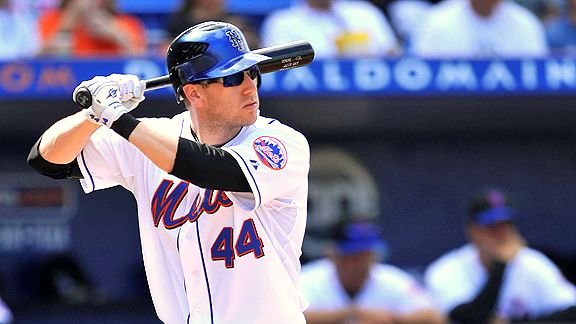
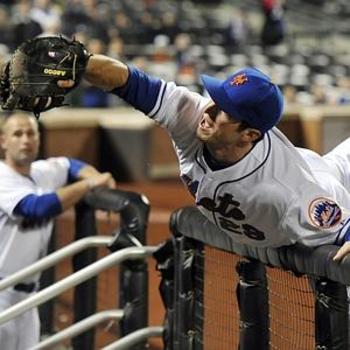
If being a Mets fan has made anything clear it's that I, apparently, have an insatiable lust for pain. Yesterday I realized that hadn't changed when I got an e-mail from the team offering five-game flex ticket packs for the upcoming season. Typically, I ignore these e-mails because the tickets are too damn expensive, but I was blinded by a huge segment of block text said "NO ORDERING FEES".
You know those things: the transaction fees that enable teams to needlessly add five bucks onto every ticket, but in actuality are complete nonsense.
So I, foolishly assuming I was about to get a deal, promptly bought a Mets flex package for this season, a season that is sure to be disappointing just like they all are. For any evidence of that, look no further than yesterday's spring training opener against Atlanta that ended in a 5-5 tie.
Yes, a tie. In baseball.
Sister kissing is an unusual phenomenon in this sport, which, as we've seen, could theoretically go on forever in a regular season game, but in the spring training no one really has the patience, which means when a game is tied after nine innings, the managers debate whether or not they really care to bake out in the sun much longer. In this case, Terry Collins and Fredi Gonzalez decided that 10 innings would be enough, and it seemed like it would be for Atlanta after they took a 5-3 lead in the top of the inning. Of course, then former-Met killer Willie Harris, who was signed this offseason with the apparent idea of "even if he sucks he won't kill us anymore", smacked a two-run homer to tie the game in the bottom of the 10th, and that was how it would stand. Were it not for my discovery that my supermarket now sells Sunset Wheat, this would have been the highlight of my week.
Considering that this was the second rally by the Mets to tie the game I'm pretty sure Saturday's tie marks the high point of New York's 2011 season. It's all downhill from here.
And when it goes downhill, I'll be there to watch six times. I made a point to pick games in my plan, since it gives you the option of choosing, that were generally in the first half of the season so that my delusions of the Mets still having a chance wouldn't have been shattered yet. Highlights include the Subway Series opener the first weekend of July, a meeting with the defending-champion Giants and Ike Davis bobblehead day on July 19th against St. Louis.
Now comes the hard part. Finding six people dumb enough to go to each game with me.
In other news, some of you might have noticed that the Oscars are tonight and I, something of an Oscar junkie as you can see from some of my zanier columns in the past, am as excited as always even though I somehow managed not to see half the Best Picture nominees this year. I bring this up because I came across a rather startling discovery this afternoon involving one of my favorite films of all time, L.A. Confidential. For those of you who have seen L.A. Confidential you know that it is, well, incredible in every way. As such, it is a constant reminder to me that the Oscars are total bunk since L.A. Confidential lost Best Picture in 1997 to some boat movie.
Either way, what I did not realize is that one of the stars of the film, Guy Pearce, who so deftly pulled off a turn as the film's protagonist Lieutenant Edmund Exley, is also a tremendous sports fan. This I should have assumed because he's also Australian and Australians love their sports. And most importantly, they love their footy.
And Guy Pearce loves his footy.
But almost more important than the fact that Guy Pearce loves his footy is that he loves one footy team in particular. And it's the right one. I was entirely unaware that Pearce grew up on his mother's deer farm in Geelong, where he endured a rough 40 years of his life before he finally saw the Cats get their first championship since four years before he was born. As far as Geelong fans go, apparently Pearce is one of the more famous ones, something that the club has noted on its own website for no apparent reason other than to say "We have a celebrity that roots for us."
Pearce is apparently such a big fan of the club that he was the no-brainer choice to narrate a special video segment on the most crucial moment of Geelong's 2009 Grand Final victory over St. Kilda.
It makes one wonder if Pearce had a bet on the match with Eric Bana, a diehard St. Kilda fan who was shown on TV in the crowd of the Grand Final that day about every four seconds or so.
In any event, it's nice to know that the main man of one of my favorite films shares a bizarre team in kind with me. Unfortunately, Pearce isn't up for any Oscars tonight, nor did L.A. Confidential take home the big prize 14 years ago, but the 2007 and 2009 Grand Final victories are far more meaningful anyway.
Besides, it could be worse. He could have been duped into buying Mets tickets.
Showing posts with label Leinenkugel's Sunset Wheat. Show all posts
Sunday, February 27, 2011
Tuesday, February 16, 2010
But I’m a Good Drunk Driver
Originally written February 1, 2010.
Perhaps the most remarkable thing about Missouri is, at least as of 2008, it is one of just eight states in the union that allows passengers in a car to drink open alcohol. While I and my compatriots took advantage of this on the way to Kauffman Stadium on July 26, 2008, it became readily apparent to me that in a town where the communal ethos every Saturday night is “I know I’m driving home drunk, but I’m a good drunk driver,” as one Kansas City resident said to me, this is unbelievably stupid. In a state where three years earlier I had seen a sign reminding Cardinals fans that “Missouri law prohibits firearms in a sporting venue with a seating capacity of 5,000 or more,” this was far more disconcerting. Then again, in a city where bars in the Waldo neighborhood sell domestic bottles for $1.50, I can’t blame them for enjoying the revelry. What Lewis Black said of Madison, Wisconsin holds true in Kansas City, Missouri.
Even with the plane ticket it’s cheaper than drinking in New York.
Regardless, I wasn’t thinking of the theoretical implications, I was just enjoying drinking my Sierra Nevada. I always thought the idea of drinking openly and brazenly on the car ride to a baseball game was a little ridiculous, or at the very least required questionable judgment. But here I was, enjoying every minute of it. Not being quite sure what was proper and yet still relishing in it was probably the theme of that trip to Kansas City for me. In a city distinctly different from my own, the brief sojourn was a wholly educational experience.
I had come to Kansas City that summer to visit Susie Sharkey, whom I had met five years earlier while working at Fairview Lake YMCA Camp. Fairview generally hired a large swath of counselors from across the country and the world, prompting me to make friends with people as close as New Jersey and as far as Australia. Kansas City lay somewhere between those two on the exotic scale.
I’m not sure when the moment occurred that Susie and I became so close, though I theorize it was probably the night during staff training when we sang an impromptu rendition of Don McLean’s “American Pie”, likely to the chagrin of everyone around us. In the years since, Susie visited me in Chicago, I visited her while she was working in a Jesuit Social Work program in Sacramento, and she visited me in New York in April of 2008. If the pattern involved alternating, well, I suppose it was my turn again.
I bought a plane ticket with a few goals in mind, namely indulging in famed Kansas City BBQ, visiting the Negro Leagues Museum, stepping foot in the state of Kansas and, obviously, seeing a Royals game. Really, it was the barbecue that was key. This trip was far more organized than my trip to Sacramento two and a half years earlier, when a winter storm-induced airline snafu caused me to spend my first day in California as the designated driver for Susie’s roommates whom I had never met before while Susie, ironically, spent the night in Chicago.
This time she was at the airport waiting for me.
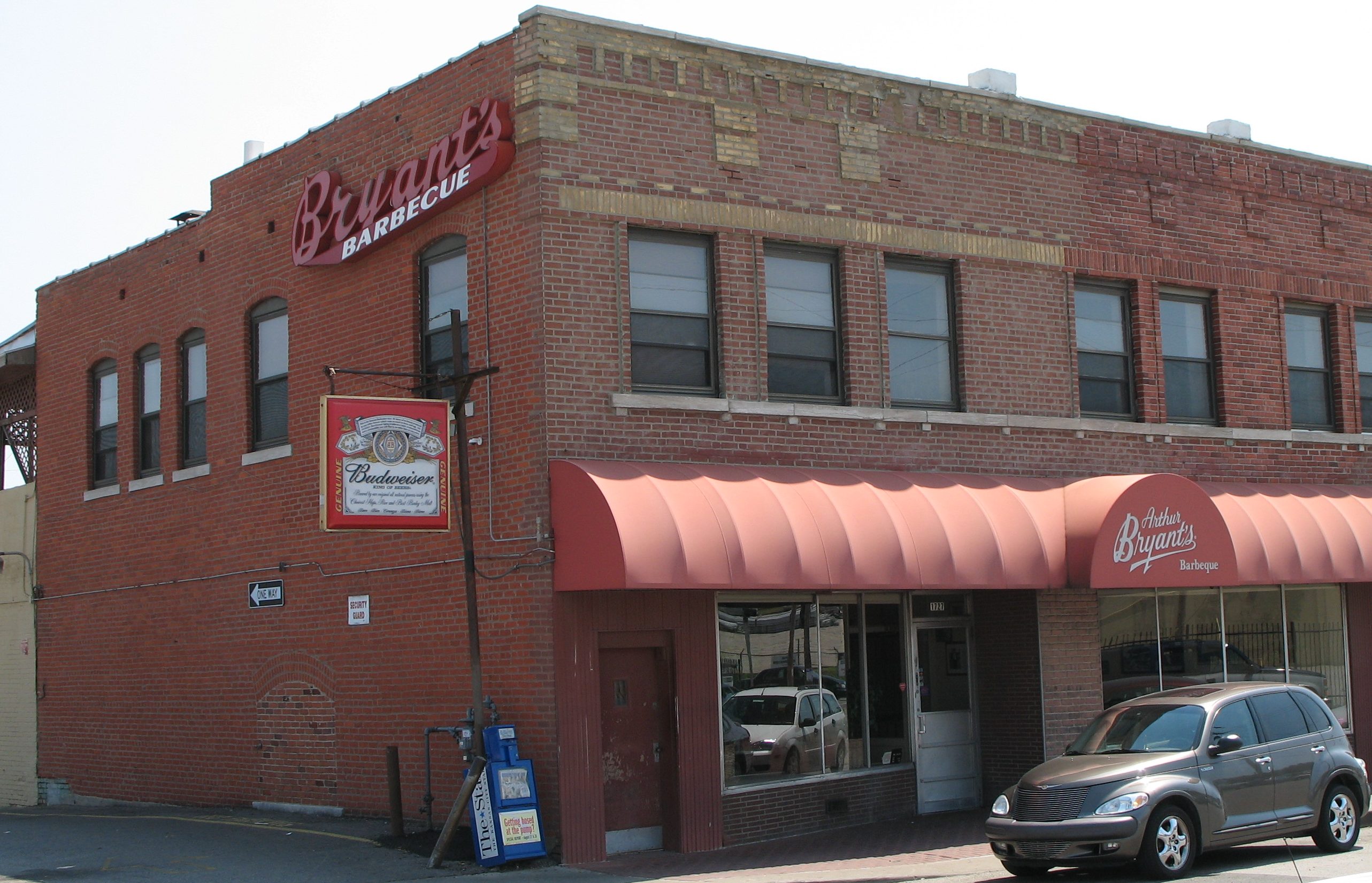
Apparently, I prepped Susie for my visit well, because she wasted little time in knocking off the first requirement, as she drove me, her friend Kathleen and her brother John directly from the airport to Arthur Bryant’s, considered by some to be the most famous barbecue restaurant in the world. While it has been patronized by all manner of celebrities – a few months after I visited GOP nominee John McCain and his running mate Sarah Palin would stop in – the décor is about as fancy as a high school dining hall.
When you eat there, however, you’re thankful that’s the case. Were they to fritter away money on repairing the chipped formica tables, it might distract them for the more pertinent task of preparing the food. I had the brisket and burnt ends, their specialty, and felt my arteries clogging almost immediately. This would be a trend for the entire weekend.
The next day Susie and I visited the Negro Leagues Baseball Museum, which is located in the same building as the American Jazz Museum and you can buy a joint entry into both of them. We did, but after the Negro Leagues Museum we were fairly wiped out. It contains a number of interesting pieces of memorabilia as well as early 20th century and late 19th century newspaper articles and posters that are riddled with hints of America’s racial tension. The one thing that struck me most, however, was that a number of the placards and exhibits were damaged or otherwise in disrepair. In most museums these things would have quickly been fixed, but much of the damage hadn’t been touched in years it seemed.
This didn’t show me so much that the museum was not well kept or curated – it was well organized and very interesting – but rather it gave you the feeling that it wasn’t fixed because people didn’t seem to care as much about this particular museum. Perhaps I’m reading too much into it, but torn plaques in exhibits would never fly at the Baseball Hall of Fame in Cooperstown, New York. But that, I feel, was long a white institution. Making sure that the dedication to African-American heritage in baseball history was just as pristine and professional just didn’t seem important to enough people, which is truly a shame. Neglecting greats like Satchel Paige, Josh Gibson and Cool Papa Bell is as tragic a situation for all of baseball as it is for black baseball. But in the racial wounds of this country, some of which will never heal, this one, I suppose, is fairly minor on the grand scale.
The barbecue tour was far from over, and Susie was as strong a partner as I could hope for. Our next stop was Oklahoma Joe’s, a slightly more well-kept, but equally as casual joint as Arthur Bryant’s that lies past a scenic drive of industrial factories at 3002 West 47th Avenue in Kansas City, KS. The line was long – it was the heart of lunch time – and the people behind the counter were good-natured and slopped an outrageous amount of food on your wax-paper covered trays. I went for the jumbo size pulled beef and pork sandwich with a side of French fries. It was probably enough calories to keep me running for a year or so.
After this, other highlights of the trip included a venture to Hallmark headquarters, an obligatory visit to Culver’s so I could get a double butter burger with cheese and frozen custard, and perhaps the most interesting, the Sprint Center in downtown KC. The thoroughly modern arena is a sharp building. Its outside is entirely made of glass and curves in a modern and tasteful fashion. The stadium is meant to be the anchor of the revitalized Power and Light District, which also has a number of apartments and restaurants, one of which, a location of the Famous Dave’s BBQ chain, was pointed out to me by Susie as a restaurant we would not be going to when there was authentic Kansas City BBQ to be had.
There is only one problem with the arena, and that is, well, no one plays there. It does regularly host concerts as well as college basketball tournaments – it is hardly vacant – but professional sports, aside from a few preseason games, have yet to make their presence felt there.
It is, however, home to the Collegiate Basketball Hall of Fame and the College Basketball Experience, which is completely awesome. Susie and I did our best to beat the buzzer with three-pointers and test our passing accuracy. Each activity has a sign explaining the museum’s rules which, adorably, include “absolutely no swearing or cursing.”
There I learned that Shaquille O’Neal, not surprisingly, has feet about twice the size of mine. Also, dunking is hard.
Really hard.
Visitors can test their skills dunking on hoops 7, 8, 9 and 10 feet high, and while, I have never been noted for my athletic prowess, I struggled with the shortest one. It was here that I came to the stunning conclusion that dunking a basketball is an obscenely difficult task. It is absurd that human beings can actually do it.
The last bit of the museum is a quiet hall denoting all the members of the college basketball Hall of Fame, which happens to be accompanied by softly playing college fight songs. I cracked a smile when “Go U Northwestern” started playing, though given NU’s inauspicious basketball history –it is the only school in the six major conferences never to make the NCAA Tournament – it seemed an odd choice. Then again, as a freshman I practiced with the Ultimate Frisbee team at Patten Gymnasium in Evanston, which hosted the first ever NCAA Tournament Championship Game in 1939. I struck up a conversation with an older man, a Michigan alum, while Susie watched on in amazement that I could reel off so much pointless sports trivia with a man three times my age. I wasn’t sure if I should be proud or seek to do more productive things with my time.
Other highlights of the weekend included a party at Susie’s house where I made sure to bring six packs both of Leinenkugel’s Sunset Wheat and Leinenkugel’s Summer Shandy, which I hid in the back of the fridge. About 10 beers later, and after generally making a fool of myself, it was time to slow down.
The next day was the main event, a Saturday night showdown at the K with Susie, her boyfriend Kevin and her friend Hennie. As the non-drivers among us sipped our beers on the car ride, we approached the stadium, which sits in a complex next to the Chiefs’ Arrowhead Stadium, and were informed by Hennie that her ex-boyfriend was apparently also attending. The potential for awkwardness abounded, but surely we wouldn’t bump into him in a stadium that held more than 38,000 people.
The odds were that we wouldn’t even see him, let alone park just a few spots away from him in the stadium lot. Ah, but the odds are odds and not certainties for a reason. Sure enough there he was, and the uncomfortable hello conversation ensued. I’m fairly convinced in the years since that this was the moment Hennie decided she no longer wanted to be at the game. I can’t say I blame her – I would probably feel uncomfortable in the same position, but having come halfway across the country to see this baseball game, I was less than sympathetic.
We bought our tickets and entered the big winding circular entrance ramp and were presented with our Dan Quisenberry Bobblehead dolls, complete with a Royals fireman’s helmet in reference to his reputation as one of the best relievers, or firemen, of his day. I would be lying if I said the giveaway didn’t factor into when I scheduled my visit to the Paris of the Plains.
Kauffman Stadium is one of the more interesting I have seen. It is fairly old, but for a building from an era typified by multi-use cylinders, it is a very modern baseball-specific design. The stadium’s upper deck has a unique slope at the ends that give it a crescent-like shape. The main stands open up to a view beyond the outfield of grassy fields and trees. While there is a road that cuts through the landscape, the picture is very idyllic, giving you the sense that while you are at a Major League game, the field connects to baseball’s mythological Field of Dreams roots. It is a simple and subtle fixture in the stadium, but there is something rare and overtly pleasant about it that I enjoy tremendously.
Adding to it are the famed fountains that sprout up beyond the centerfield wall. I have always remembered them as a special characteristic of the building since I first saw a game in Kansas City on ESPN as a child. Seeing them in person is interesting, if for no other reason than because those types of ballpark features were practically unheard of when the K was built. The fountain is the largest privately funded one in the world, and gives the stadium authentic charm that is often sought and rarely matched in newer buildings. Make no mistake, the building is uniquely 1970s in its design, which bears many similarities to cookie-cutter stadiums such as its steep upper deck, but it is also unique in a number of ways.
At the time I was there, the building was in the midst of a major renovation designed at adding restaurants and luxury seating which would keep the Royals competitive in the ever financially expanding Major Leagues. As a result, the gigantic Royals crown that typically circles the top of the scoreboard lay in pieces on the grass beyond the right field wall. Part of the renovations, a positively enormous LED scoreboard – at the time the world’s largest – was already installed.
Opposite Kansas City’s starter, a rookie right-hander with high hopes named Luke Hochevar, was Tampa Bay ace Scott Kazmir. As a Mets fan, watching Kazmir pitch in a Rays uniform still hurt. Kazmir had been a highly touted prospect for New York until 2004 when he was dealt in a foolishly lopsided trade to the Rays for the eternal Victor Zambrano.
In the years since, Kazmir has become an all star. By 2008, Zambrano was out of baseball.
The Royals played the Rays close, keeping the game tied at 2-2 for the first five innings, and then, like so much bad luck, the rains came. A 73-minute delay was sparked by a rain and hail storm that provided some beautiful red skies in the distance but also resulted in a lot of soaked clothes. I, having never been there before and never a fan of leaving early, made it a point to stay. Susie was reluctantly willing to back me on this, at least for a brief period, and Kevin, too stuck with me.
Hennie, was less than enthusiastic. Her feelings might have been influenced by the fact that not only was her ex-boyfriend at the game, but he was seated in the same section as us. We stuck out the rains, but eventually everyone had gotten grouchy except me and with the majority – and the moisture – ruling, we headed to the car shortly after the delay ended.
The next day, Susie and I made one more stop on the way to the airport, a lunch at the popular Kansas City-area chain Gates Bar-B-Q. Gates, along with Arthur Bryant’s, is one of two area restaurants that draws roots from the father of Kansas City barbecue, Henry Perry. Ironically, Gates is the only place in Kansas City that I actually had ribs at. The sauce was a nice change of pace, tangy like the others but with a peppery kick at the end. I decided to splurge on the $3 and buy a bottle to take home.
By the end of the trip I was thoroughly worn down and full of more barbecue sauce than I think any normal person should eat in a year, let alone a weekend. After Susie dropped me off at the airport, a place that in and of itself was a new experience because of how much smaller it was than any other airport I had been to, I went to the desk to get my ticket and when asked to check my bag, I told the clerk, “No thanks.” I had made a point to borrow a rolling weekend bag from my roommate, Brandon, so I wouldn’t have to bother with baggage claim when I got home, particularly since my flight wasn’t direct.
As I went through security, the woman checking bags, a skinny blond in her 50s, sharply informed me of a problem.
“You can’t take the barbecue sauce on the plane, sir.”
Federal regulations don’t allow you to bring liquids larger than three ounces in volume onto planes as a carry-on item. While I have no problem with the rules, I am always stunned at how much more pointed and dedicated to enforcing them I’ve found security people at smaller airports to be than their counterparts in major population centers that are more likely targets of terrorism. Annoyed, I went back to the clerk to check my bag rather than throw out my memento of Kansas City.

“Back again, huh?” the clerk said.
“Yes, apparently my barbecue sauce is too dangerous to bring on the plane,” I told her.
If there was nothing else I learned in Kansas City that weekend, it was that the people are very perceptive. And they also know their barbecue.
“Is it Gates?”
“Actually, yes it is.”
“Yeah,” she said. “That stuff’s pretty potent.”
Even with the plane ticket it’s cheaper than drinking in New York.
Regardless, I wasn’t thinking of the theoretical implications, I was just enjoying drinking my Sierra Nevada. I always thought the idea of drinking openly and brazenly on the car ride to a baseball game was a little ridiculous, or at the very least required questionable judgment. But here I was, enjoying every minute of it. Not being quite sure what was proper and yet still relishing in it was probably the theme of that trip to Kansas City for me. In a city distinctly different from my own, the brief sojourn was a wholly educational experience.
I had come to Kansas City that summer to visit Susie Sharkey, whom I had met five years earlier while working at Fairview Lake YMCA Camp. Fairview generally hired a large swath of counselors from across the country and the world, prompting me to make friends with people as close as New Jersey and as far as Australia. Kansas City lay somewhere between those two on the exotic scale.
I’m not sure when the moment occurred that Susie and I became so close, though I theorize it was probably the night during staff training when we sang an impromptu rendition of Don McLean’s “American Pie”, likely to the chagrin of everyone around us. In the years since, Susie visited me in Chicago, I visited her while she was working in a Jesuit Social Work program in Sacramento, and she visited me in New York in April of 2008. If the pattern involved alternating, well, I suppose it was my turn again.
I bought a plane ticket with a few goals in mind, namely indulging in famed Kansas City BBQ, visiting the Negro Leagues Museum, stepping foot in the state of Kansas and, obviously, seeing a Royals game. Really, it was the barbecue that was key. This trip was far more organized than my trip to Sacramento two and a half years earlier, when a winter storm-induced airline snafu caused me to spend my first day in California as the designated driver for Susie’s roommates whom I had never met before while Susie, ironically, spent the night in Chicago.
This time she was at the airport waiting for me.
Apparently, I prepped Susie for my visit well, because she wasted little time in knocking off the first requirement, as she drove me, her friend Kathleen and her brother John directly from the airport to Arthur Bryant’s, considered by some to be the most famous barbecue restaurant in the world. While it has been patronized by all manner of celebrities – a few months after I visited GOP nominee John McCain and his running mate Sarah Palin would stop in – the décor is about as fancy as a high school dining hall.
When you eat there, however, you’re thankful that’s the case. Were they to fritter away money on repairing the chipped formica tables, it might distract them for the more pertinent task of preparing the food. I had the brisket and burnt ends, their specialty, and felt my arteries clogging almost immediately. This would be a trend for the entire weekend.
The next day Susie and I visited the Negro Leagues Baseball Museum, which is located in the same building as the American Jazz Museum and you can buy a joint entry into both of them. We did, but after the Negro Leagues Museum we were fairly wiped out. It contains a number of interesting pieces of memorabilia as well as early 20th century and late 19th century newspaper articles and posters that are riddled with hints of America’s racial tension. The one thing that struck me most, however, was that a number of the placards and exhibits were damaged or otherwise in disrepair. In most museums these things would have quickly been fixed, but much of the damage hadn’t been touched in years it seemed.
This didn’t show me so much that the museum was not well kept or curated – it was well organized and very interesting – but rather it gave you the feeling that it wasn’t fixed because people didn’t seem to care as much about this particular museum. Perhaps I’m reading too much into it, but torn plaques in exhibits would never fly at the Baseball Hall of Fame in Cooperstown, New York. But that, I feel, was long a white institution. Making sure that the dedication to African-American heritage in baseball history was just as pristine and professional just didn’t seem important to enough people, which is truly a shame. Neglecting greats like Satchel Paige, Josh Gibson and Cool Papa Bell is as tragic a situation for all of baseball as it is for black baseball. But in the racial wounds of this country, some of which will never heal, this one, I suppose, is fairly minor on the grand scale.
The barbecue tour was far from over, and Susie was as strong a partner as I could hope for. Our next stop was Oklahoma Joe’s, a slightly more well-kept, but equally as casual joint as Arthur Bryant’s that lies past a scenic drive of industrial factories at 3002 West 47th Avenue in Kansas City, KS. The line was long – it was the heart of lunch time – and the people behind the counter were good-natured and slopped an outrageous amount of food on your wax-paper covered trays. I went for the jumbo size pulled beef and pork sandwich with a side of French fries. It was probably enough calories to keep me running for a year or so.
After this, other highlights of the trip included a venture to Hallmark headquarters, an obligatory visit to Culver’s so I could get a double butter burger with cheese and frozen custard, and perhaps the most interesting, the Sprint Center in downtown KC. The thoroughly modern arena is a sharp building. Its outside is entirely made of glass and curves in a modern and tasteful fashion. The stadium is meant to be the anchor of the revitalized Power and Light District, which also has a number of apartments and restaurants, one of which, a location of the Famous Dave’s BBQ chain, was pointed out to me by Susie as a restaurant we would not be going to when there was authentic Kansas City BBQ to be had.
There is only one problem with the arena, and that is, well, no one plays there. It does regularly host concerts as well as college basketball tournaments – it is hardly vacant – but professional sports, aside from a few preseason games, have yet to make their presence felt there.
It is, however, home to the Collegiate Basketball Hall of Fame and the College Basketball Experience, which is completely awesome. Susie and I did our best to beat the buzzer with three-pointers and test our passing accuracy. Each activity has a sign explaining the museum’s rules which, adorably, include “absolutely no swearing or cursing.”
There I learned that Shaquille O’Neal, not surprisingly, has feet about twice the size of mine. Also, dunking is hard.
Really hard.
Visitors can test their skills dunking on hoops 7, 8, 9 and 10 feet high, and while, I have never been noted for my athletic prowess, I struggled with the shortest one. It was here that I came to the stunning conclusion that dunking a basketball is an obscenely difficult task. It is absurd that human beings can actually do it.
The last bit of the museum is a quiet hall denoting all the members of the college basketball Hall of Fame, which happens to be accompanied by softly playing college fight songs. I cracked a smile when “Go U Northwestern” started playing, though given NU’s inauspicious basketball history –it is the only school in the six major conferences never to make the NCAA Tournament – it seemed an odd choice. Then again, as a freshman I practiced with the Ultimate Frisbee team at Patten Gymnasium in Evanston, which hosted the first ever NCAA Tournament Championship Game in 1939. I struck up a conversation with an older man, a Michigan alum, while Susie watched on in amazement that I could reel off so much pointless sports trivia with a man three times my age. I wasn’t sure if I should be proud or seek to do more productive things with my time.
Other highlights of the weekend included a party at Susie’s house where I made sure to bring six packs both of Leinenkugel’s Sunset Wheat and Leinenkugel’s Summer Shandy, which I hid in the back of the fridge. About 10 beers later, and after generally making a fool of myself, it was time to slow down.
The next day was the main event, a Saturday night showdown at the K with Susie, her boyfriend Kevin and her friend Hennie. As the non-drivers among us sipped our beers on the car ride, we approached the stadium, which sits in a complex next to the Chiefs’ Arrowhead Stadium, and were informed by Hennie that her ex-boyfriend was apparently also attending. The potential for awkwardness abounded, but surely we wouldn’t bump into him in a stadium that held more than 38,000 people.
The odds were that we wouldn’t even see him, let alone park just a few spots away from him in the stadium lot. Ah, but the odds are odds and not certainties for a reason. Sure enough there he was, and the uncomfortable hello conversation ensued. I’m fairly convinced in the years since that this was the moment Hennie decided she no longer wanted to be at the game. I can’t say I blame her – I would probably feel uncomfortable in the same position, but having come halfway across the country to see this baseball game, I was less than sympathetic.
We bought our tickets and entered the big winding circular entrance ramp and were presented with our Dan Quisenberry Bobblehead dolls, complete with a Royals fireman’s helmet in reference to his reputation as one of the best relievers, or firemen, of his day. I would be lying if I said the giveaway didn’t factor into when I scheduled my visit to the Paris of the Plains.
Kauffman Stadium is one of the more interesting I have seen. It is fairly old, but for a building from an era typified by multi-use cylinders, it is a very modern baseball-specific design. The stadium’s upper deck has a unique slope at the ends that give it a crescent-like shape. The main stands open up to a view beyond the outfield of grassy fields and trees. While there is a road that cuts through the landscape, the picture is very idyllic, giving you the sense that while you are at a Major League game, the field connects to baseball’s mythological Field of Dreams roots. It is a simple and subtle fixture in the stadium, but there is something rare and overtly pleasant about it that I enjoy tremendously.
Adding to it are the famed fountains that sprout up beyond the centerfield wall. I have always remembered them as a special characteristic of the building since I first saw a game in Kansas City on ESPN as a child. Seeing them in person is interesting, if for no other reason than because those types of ballpark features were practically unheard of when the K was built. The fountain is the largest privately funded one in the world, and gives the stadium authentic charm that is often sought and rarely matched in newer buildings. Make no mistake, the building is uniquely 1970s in its design, which bears many similarities to cookie-cutter stadiums such as its steep upper deck, but it is also unique in a number of ways.
At the time I was there, the building was in the midst of a major renovation designed at adding restaurants and luxury seating which would keep the Royals competitive in the ever financially expanding Major Leagues. As a result, the gigantic Royals crown that typically circles the top of the scoreboard lay in pieces on the grass beyond the right field wall. Part of the renovations, a positively enormous LED scoreboard – at the time the world’s largest – was already installed.
Opposite Kansas City’s starter, a rookie right-hander with high hopes named Luke Hochevar, was Tampa Bay ace Scott Kazmir. As a Mets fan, watching Kazmir pitch in a Rays uniform still hurt. Kazmir had been a highly touted prospect for New York until 2004 when he was dealt in a foolishly lopsided trade to the Rays for the eternal Victor Zambrano.
In the years since, Kazmir has become an all star. By 2008, Zambrano was out of baseball.
The Royals played the Rays close, keeping the game tied at 2-2 for the first five innings, and then, like so much bad luck, the rains came. A 73-minute delay was sparked by a rain and hail storm that provided some beautiful red skies in the distance but also resulted in a lot of soaked clothes. I, having never been there before and never a fan of leaving early, made it a point to stay. Susie was reluctantly willing to back me on this, at least for a brief period, and Kevin, too stuck with me.
Hennie, was less than enthusiastic. Her feelings might have been influenced by the fact that not only was her ex-boyfriend at the game, but he was seated in the same section as us. We stuck out the rains, but eventually everyone had gotten grouchy except me and with the majority – and the moisture – ruling, we headed to the car shortly after the delay ended.
The next day, Susie and I made one more stop on the way to the airport, a lunch at the popular Kansas City-area chain Gates Bar-B-Q. Gates, along with Arthur Bryant’s, is one of two area restaurants that draws roots from the father of Kansas City barbecue, Henry Perry. Ironically, Gates is the only place in Kansas City that I actually had ribs at. The sauce was a nice change of pace, tangy like the others but with a peppery kick at the end. I decided to splurge on the $3 and buy a bottle to take home.
By the end of the trip I was thoroughly worn down and full of more barbecue sauce than I think any normal person should eat in a year, let alone a weekend. After Susie dropped me off at the airport, a place that in and of itself was a new experience because of how much smaller it was than any other airport I had been to, I went to the desk to get my ticket and when asked to check my bag, I told the clerk, “No thanks.” I had made a point to borrow a rolling weekend bag from my roommate, Brandon, so I wouldn’t have to bother with baggage claim when I got home, particularly since my flight wasn’t direct.
As I went through security, the woman checking bags, a skinny blond in her 50s, sharply informed me of a problem.
“You can’t take the barbecue sauce on the plane, sir.”
Federal regulations don’t allow you to bring liquids larger than three ounces in volume onto planes as a carry-on item. While I have no problem with the rules, I am always stunned at how much more pointed and dedicated to enforcing them I’ve found security people at smaller airports to be than their counterparts in major population centers that are more likely targets of terrorism. Annoyed, I went back to the clerk to check my bag rather than throw out my memento of Kansas City.
“Back again, huh?” the clerk said.
“Yes, apparently my barbecue sauce is too dangerous to bring on the plane,” I told her.
If there was nothing else I learned in Kansas City that weekend, it was that the people are very perceptive. And they also know their barbecue.
“Is it Gates?”
“Actually, yes it is.”
“Yeah,” she said. “That stuff’s pretty potent.”
Sunday, February 7, 2010
Well, I Guess I Was Wrong
Yes, I'm aware I picked the Colts to win, and frankly, I feel like I had sound logic to rely on, but alas, that is why they play the games. I don't know that I really have the energy to go into all of my thoughts on the game, but for now I'll give you some bullet points.
-- The Saints won the game when they went for it on fourth down in the first half and didn't get it. Sean Payton is a gambler, and that onside kick to start the second half, aside from being perhaps the game's most crucial play, was a pretty clear manifestation of that. But once he showed his team that he was willing to risk the game on them, it was a signal to the players that they were going to get it done. They clearly relished the risk.
-- Lance Moore will not be remembered as the key player of this game, but he made the play of the game when he contorted his body to stretch for the two-point conversation after New Orleans took the lead in the fourth quarter.
-- Dwight Freeney was effective early, but by the third quarter it was clear that his ankle was affecting him. My guess is he was on so many cortizone shots that he couldn't even feel anything below his knee. He may not be walking for a while.
-- Despite that late pick, Peyton Manning actually played an exceptional game. He was 31 of 45 for 333 yards a touchdown and an interception.
-- Jim Caldwell was overwhelmed by the moment, as shown by the fact that he didn't call time out before the Colts' fourth down in the final minute.
-- The Saints executed an excellent Gatorade Dump on Sean Payton, who thoroughly enjoyed the shower.
-- The Colts lost because they had never been in a close game this season. When it came to crunch time, they had no idea how to react.
-- Reggie Wayne absolutely should have had that catch in the end zone at the end of the game.
-- I said early in the game that if Joseph Addai won MVP I would eat my hat. I came dangerously close to it.
-- This afternoon's Capitals-Penguins game, which featured Washington winning its 14th in a row by rallying to win in overtime on the strength of a hat trick by Alex Ovechkin was a better game than the Super Bowl.
That's all I got. This wasn't the best Super Bowl I've ever seen, but it was a pretty good one. And it was far closer than the two-touchdowns New Orleans eventually won by. What made it even better was that I have a fridge heavily stocked with Leinenkugel's Sunset Wheat as a result.
Tomorrow it's off to Philadelphia for team No. 31, the Flyers. As a result, I may not get a chance to post a story because I will probably be in transit, but if that's the case, I'll be sure to have it up on Tuesday.
-- The Saints won the game when they went for it on fourth down in the first half and didn't get it. Sean Payton is a gambler, and that onside kick to start the second half, aside from being perhaps the game's most crucial play, was a pretty clear manifestation of that. But once he showed his team that he was willing to risk the game on them, it was a signal to the players that they were going to get it done. They clearly relished the risk.
-- Lance Moore will not be remembered as the key player of this game, but he made the play of the game when he contorted his body to stretch for the two-point conversation after New Orleans took the lead in the fourth quarter.
-- Dwight Freeney was effective early, but by the third quarter it was clear that his ankle was affecting him. My guess is he was on so many cortizone shots that he couldn't even feel anything below his knee. He may not be walking for a while.
-- Despite that late pick, Peyton Manning actually played an exceptional game. He was 31 of 45 for 333 yards a touchdown and an interception.
-- Jim Caldwell was overwhelmed by the moment, as shown by the fact that he didn't call time out before the Colts' fourth down in the final minute.
-- The Saints executed an excellent Gatorade Dump on Sean Payton, who thoroughly enjoyed the shower.
-- The Colts lost because they had never been in a close game this season. When it came to crunch time, they had no idea how to react.
-- Reggie Wayne absolutely should have had that catch in the end zone at the end of the game.
-- I said early in the game that if Joseph Addai won MVP I would eat my hat. I came dangerously close to it.
-- This afternoon's Capitals-Penguins game, which featured Washington winning its 14th in a row by rallying to win in overtime on the strength of a hat trick by Alex Ovechkin was a better game than the Super Bowl.
That's all I got. This wasn't the best Super Bowl I've ever seen, but it was a pretty good one. And it was far closer than the two-touchdowns New Orleans eventually won by. What made it even better was that I have a fridge heavily stocked with Leinenkugel's Sunset Wheat as a result.
Tomorrow it's off to Philadelphia for team No. 31, the Flyers. As a result, I may not get a chance to post a story because I will probably be in transit, but if that's the case, I'll be sure to have it up on Tuesday.
Labels:
Dwight Freeney,
Indianapolis Colts,
Jim Caldwell,
Joseph Addai,
Lance Moore,
Leinenkugel's Sunset Wheat,
New Orleans Saints,
Peyton Manning,
Philadelphia Flyers,
Sean Payton,
Super Bowl XLIV
Tuesday, January 26, 2010
Goodbye College, Hello Cleveland
Originally written January 14, 2010
The last few days of college are a bizarre time, particularly for those of us who are without a job or any real idea of where they’re going in life. I had no job lined up and prospects were pretty scarce. I applied to 100 or so over the final few weeks as I wrote my last papers and began packing up. Most of the calls had come from news clipping organizations I had little interest in working for that would have required me to be in the office by 4:30 a.m. on some days. Beyond that the ways to find a job writing in sports in New York without having ever actually interned for a major newspaper seemed few and far between.
I believe it was my stepmother, Audrey, who asked me what I wanted to do for a living the day I graduated. The latter of my two commencements ended at Welsh-Ryan Arena in Evanston and as we went through the obligatory picture taking session by Ryan Field, Northwestern’s football stadium, she posed the question.
“I want to watch baseball,” I said. “For money.”
It was always good for a laugh, and yet I wasn’t particularly sure where I’d go. I had tried my best to balance mailing out resumes, packing my things, and squeezing in all the necessary goodbyes and drunken memories that the final two weeks after finals provide you with. Those goodbyes are tricky. You’re not sure which of the people you’ve spent the last four years with you’re going to still be in contact with and who you need to say goodbye to for good.
And there are some.
But you can’t afford to be too schmaltzy or else your life will never get where it’s going. You just have to take it in stride. And it ain’t easy. But you manage.
I tried not to let it on as I packed my room and scrambled to sell furniture that I wouldn’t be taking back east, but jobless me was a nervous wreck and what laid ahead was a mystery. Fortunately, I had one carrot to distract me from the uncertainty before my mother and I caravanned two cars full of four years back to New Jersey.
For me, I generally would drive from my childhood home in Millburn to Evanston in one shot if I were by myself – all twelve hours of it. My mother couldn’t stand to sit in the car that long in one day and whenever I made the trip with her, we would break it in two, often staying at the same Hampton Inn in Milan, Ohio that had a rather pungent textile factory across the highway from it. That wasn’t always bad, as we would usually eat at the same restaurant, a BBQ grill joint called the Roadhouse, which was the type of place that served you your rack of baby back ribs with a side of 5 oz. grilled sirloin.
But for the trip home my mother had suggested that we instead stay in a nice hotel in Cleveland and treat ourselves. The actual hotel itself that we stayed in was of little interest or import to me, but I did notice one thing that was.
The Indians were in town.
That sealed the deal. When I originally asked my mother if the Indians were in town she told me she had already checked and that they were not playing the Mets. Of course, given that they play in two different leagues, the chances that the Mets would be there that week were scant anyway, but Cleveland was playing Philadelphia. At the very least I could root against the rival Phils. I decided to be the generous one and buy the tickets – after all, my parents had just paid for four years at a private college, I could give my mom a break – and I found two seats in row GG not far behind home plate for the Wednesday evening tilt on June 20, 2007.
And the seats came out to a mere $50 each. I love being impressed by ticket prices that aren’t in New York.
Of course, before the game came there was still the nasty business of graduating, writing my final papers, doing my drinking, saying my goodbyes, packing for home and selling my furniture. The furniture would be the most immediately impactful as I slept on my own bed one night before selling it, then slept on the bed my roommate had left before selling that, and then spent the last night sleeping on our disgusting couch.
The abruptness of the transition is confusing if for no other reason than that you’re not always sure how sentimental to get. Luisa had come over to give me company while I packed my final things and when she left nonchalantly said, “Well, it was fun going to college with you.” It seems simple, but sometimes you aren’t sure how serious to take these things, particularly since in the case of Luisa, we have kept close contact since graduating and college no longer appears to be the basis of our friendship so much as one chapter of it.
This is the case with a number of my close friends, but not so much with others. Knowing who will and won’t stay a part of your life is probably the most uncertain and difficult aspect of transitioning to the real world. Perhaps that's one of the reasons I'm doing this: To have an excuse to go around the country and keep in touch with all of them.
Still, at the time I was far more preoccupied with packing and getting on the road quickly on the 20th. The game itself was the night that we were leaving Evanston, which meant we’d have to make a quick exit to ensure we made it to Cleveland in time for the 7 o’clock start. This would be delayed by, as so often happens between children and their mothers at moments of heightened stress, a fight. In this case it revolved around a parking ticket my mother had gotten while we were loading up the cars that morning and my juvenile insistence that she simply ignore it so we could hit the road.
With the city backlog, my logic went, they’d never know the difference.
This, of course, did not sit well with my mother who made a point to go to the town municipal center and pay the ticket. Considering town hall was next to my apartment building, this wasn’t too big of a diversion.
After getting on the road, cooler heads began to prevail and we left one car behind the other on Lake Shore Drive, where I got my last looks at the city I had called home for four years. As I teetered between lead-footed and sentimental we eventually found our way onto I-80 and, with 90 minutes or so to spare, pulled into the Hilton Garden Inn in Cleveland.
My mother and I checked in and headed to the stadium just a few blocks away. Jacobs Field, or the Jake as it is colloquially known, is often considered one of the best parks in the Majors. This doesn’t come from any sort of trendsetting architecture. The modern trend of faux-retro parks still pulls its impetus from Camden Yards, which beat the Jake to opening day by a few years.
But indeed the intimacy and sight lines are among the best in baseball. To me, however, the most striking architectural feature is outside the stadium. The building’s structure features visible steel beams all around its exterior that give the appearance of an exoskeleton holding the stands up. What was most fascinating to me, however, is that the skeleton and its older style stadium lights are painted a bright white, making them stand out and giving the building an individualized and unique appearance that straddles the line between antiquated and futuristic.
The inside has a few features that might make it seem noteworthy, but nothing overwhelms anything else – with, perhaps, the notable exception of the 149-foot long video screen in left field. At the time it became my favorite park in the Majors. I can’t begin to imagine how much more pleasant it is to watch a game there than it was to do so in the Indians’ former home, the monstrous Cleveland Municipal Stadium, which housed 74,438 fans as opposed to the relatively cozy 43,515-seat capacity of the Jake.
I decided, as I often do, to take a stroll around the park and view it from different angles and see what it has to offer. As I continued my walk I happened upon Heritage Park, a circular museum dedicated to the Indians’ hall of famers and major moments that resides behind the batters eye in center field. Apparently it had just opened that year, but regardless, I hadn’t seen a hall of fame section that was quite so aesthetically pleasing in its subtle appearance and seamlessly weaved into the style of the ballpark. As I’ve visited more parks that have added their own hall of fame sections, I’ve enjoyed seeing the different orientations, but this one teaches you about the club’s history while still maintaining its presence as part of a stadium.
And speaking of being part of a stadium, the outfield concourse at Jacobs Field features a beer garden. Yes, these are common now, but this was the first time I had spotted it, or perhaps as a 21-year-old this was the first time I took note. I don’t much like drinking at ball games. If you have too much the whole experience moves too quickly and you lose track of what’s happening on the field. In the case of baseball, I understand this is preferable for some people but I’m far more concerned with seeing the tension that develops between the pitcher and the batter, and having five too many beers in me makes that infinitely more difficult to keep track of. Regardless, I suppose having the open air beer garden is necessary considering Jacobs Field was paid for by a 15-year sin tax on cigarettes and alcohol.
I will say this, though. The fans at the beer garden certainly looked like they were having fun. In the end that, I suppose, is the key to the experience.
And speaking of beer, as I walked back to my seat I passed by a stand that was selling Leinenkugel’s Sunset Wheat on tap. Sunset Wheat, as any of my close friends could tell you, is my favorite beer on the planet. It’s like candy. The big problem with this lies in the fact that Leinenkugel’s, based in Chippewa Falls, Wisconsin, hadn’t spread much out east. In fact, I had never seen it east of Chicago in my lifetime, to the point that I had made sure to buy a six pack of it before driving back to New Jersey much like I had always made sure to bring a healthy supply of Yeungling back to Evanston.
I don’t really buy beer at baseball games, both because it distracts me and because, usually, it’s outrageously expensive. I don’t need to spend $9.75 on a Miller Lite. But with the prospects of never seeing Sunset Wheat when I returned to the east coast staring me in the face, I bit the bullet – it was only seven dollars – and bought myself a beer to take back to my seat.
Ironically, I would see a six pack of it at the Kings Supermarket in Short Hills, New Jersey a week later. Leinie’s, evidently, had chosen to expand just in time.
The park was more than 50% full that night, but I was still surprised with the turnout after being accustomed to always seeing a full house on TV. In fact, Cleveland sold out the first 455 games at the Jake, a Major League record at the time, which is commemorated with “455” being among the retired numbers that hang against the brick walls in the right field portion of the upper deck.
Granted it was a week night, but the night I was there, the official attendance was a mere 53.7% of capacity at 24,278. For me, however, the average crowd didn’t take away from the game, which, for its first 5 ½ innings was a rather taut affair. Cleveland and Philadelphia had been tied, 2-2, leading up to the sixth inning, when the Phillies took a 4-2 lead courtesy of a two-run homer by Rod Barajas. The Indians responded in the bottom half of the inning by scoring eight runs and having eight consecutive batters reach base to put the game away. C.C. Sabathia pitched six innings to earn the win, becoming the first Indian to get 10 wins in seven consecutive seasons since Addie Joss turned the trick for Cleveland a century earlier from 1902-1909.
As a rule I will almost never leave a game early, particularly if I’m in a new stadium. My diligence paid off in the top of the ninth inning when Shane Victorino came to bat for Philadelphia with two outs. Victorino had two strikes on him when he fouled off a high pitch that banged off the façade of the second deck and dropped down directly in front of my mother and I.
I never will understand why we scrape so violently and irrationally for a dinged up piece of cowhide, but there I was diving to the ground with my sole competition a glasses bedecked woman who appeared to be in her mid-30s. The woman may have been closer to the ball.
But I don’t care. I got it. It was mine. After two decades of watching baseball games and dozens of close calls, at long last, I had caught a foul ball.
The man sitting to my right asked if he could look at it, and perhaps I was too used to trusting everyone in the Midwest as I handed it over to him. Fortunately, he, too, was a trusting non-east coaster. He glanced at the black scuff mark left by Victorino’s bat, handed it back to me and, with a smile, said, “Congratulations.”
On the way out of the park my mother anxiously told me to stop staring at the ball as we walked back to our hotel for fear someone would steal it. Once we returned, I began telling the world, which seemed far less excited about it than I was, before finally getting some rest for the next day’s drive home.
24 hours later, I pulled into our driveway behind my mother, walked inside, and that was it.
College was over.
I remember the morning after my bar mitzvah dealing with the depression that comes after the passing of a major life event. I was older and more capable of handling it now, but this was far more daunting. I now had to find a way to move on. I had to find something to do.
My first post-college job interview was with an HR person at Time Inc, who was testing my worthiness to be employed at SI.com. I admit that I was unprepared. At the very least I should have gone to the website that morning to familiarize myself with it. Of course, that problem didn’t really prepare me for the woman’s first question:
“If an unexpected occurrence were to arise in the office, what contingency would you have prepared for that paradigm?”
I stumbled my way through some nonsense response that showed how unprepared I was and probably cost me the job immediately – I was ushered out of the office shortly afterwards – but what I wanted to say to her was, “You know people don’t talk like that in the real world, right?”
After killing time with my friend Matt for a few hours, I headed to Chelsea Market to interview at MLB.com for the position of a night shift web producer. The atmosphere was far more relaxed and much less formal, and the first thing I had to do was take a written test on baseball trivia. At the very least, even if I blew another interview, at least I’d have some fun.
Afterwards, I went home to continue my post college malaise as I tried to find direction and, most importantly, a source of income, uncertain of what the immediate future would bring.
Two nights later I got an e-mail from the night production manager at MLB.com. I would be watching baseball for money.
The last few days of college are a bizarre time, particularly for those of us who are without a job or any real idea of where they’re going in life. I had no job lined up and prospects were pretty scarce. I applied to 100 or so over the final few weeks as I wrote my last papers and began packing up. Most of the calls had come from news clipping organizations I had little interest in working for that would have required me to be in the office by 4:30 a.m. on some days. Beyond that the ways to find a job writing in sports in New York without having ever actually interned for a major newspaper seemed few and far between.
I believe it was my stepmother, Audrey, who asked me what I wanted to do for a living the day I graduated. The latter of my two commencements ended at Welsh-Ryan Arena in Evanston and as we went through the obligatory picture taking session by Ryan Field, Northwestern’s football stadium, she posed the question.
“I want to watch baseball,” I said. “For money.”
And there are some.
But you can’t afford to be too schmaltzy or else your life will never get where it’s going. You just have to take it in stride. And it ain’t easy. But you manage.
I tried not to let it on as I packed my room and scrambled to sell furniture that I wouldn’t be taking back east, but jobless me was a nervous wreck and what laid ahead was a mystery. Fortunately, I had one carrot to distract me from the uncertainty before my mother and I caravanned two cars full of four years back to New Jersey.
For me, I generally would drive from my childhood home in Millburn to Evanston in one shot if I were by myself – all twelve hours of it. My mother couldn’t stand to sit in the car that long in one day and whenever I made the trip with her, we would break it in two, often staying at the same Hampton Inn in Milan, Ohio that had a rather pungent textile factory across the highway from it. That wasn’t always bad, as we would usually eat at the same restaurant, a BBQ grill joint called the Roadhouse, which was the type of place that served you your rack of baby back ribs with a side of 5 oz. grilled sirloin.
But for the trip home my mother had suggested that we instead stay in a nice hotel in Cleveland and treat ourselves. The actual hotel itself that we stayed in was of little interest or import to me, but I did notice one thing that was.
The Indians were in town.
That sealed the deal. When I originally asked my mother if the Indians were in town she told me she had already checked and that they were not playing the Mets. Of course, given that they play in two different leagues, the chances that the Mets would be there that week were scant anyway, but Cleveland was playing Philadelphia. At the very least I could root against the rival Phils. I decided to be the generous one and buy the tickets – after all, my parents had just paid for four years at a private college, I could give my mom a break – and I found two seats in row GG not far behind home plate for the Wednesday evening tilt on June 20, 2007.
And the seats came out to a mere $50 each. I love being impressed by ticket prices that aren’t in New York.
Of course, before the game came there was still the nasty business of graduating, writing my final papers, doing my drinking, saying my goodbyes, packing for home and selling my furniture. The furniture would be the most immediately impactful as I slept on my own bed one night before selling it, then slept on the bed my roommate had left before selling that, and then spent the last night sleeping on our disgusting couch.
The abruptness of the transition is confusing if for no other reason than that you’re not always sure how sentimental to get. Luisa had come over to give me company while I packed my final things and when she left nonchalantly said, “Well, it was fun going to college with you.” It seems simple, but sometimes you aren’t sure how serious to take these things, particularly since in the case of Luisa, we have kept close contact since graduating and college no longer appears to be the basis of our friendship so much as one chapter of it.
This is the case with a number of my close friends, but not so much with others. Knowing who will and won’t stay a part of your life is probably the most uncertain and difficult aspect of transitioning to the real world. Perhaps that's one of the reasons I'm doing this: To have an excuse to go around the country and keep in touch with all of them.
Still, at the time I was far more preoccupied with packing and getting on the road quickly on the 20th. The game itself was the night that we were leaving Evanston, which meant we’d have to make a quick exit to ensure we made it to Cleveland in time for the 7 o’clock start. This would be delayed by, as so often happens between children and their mothers at moments of heightened stress, a fight. In this case it revolved around a parking ticket my mother had gotten while we were loading up the cars that morning and my juvenile insistence that she simply ignore it so we could hit the road.
With the city backlog, my logic went, they’d never know the difference.
This, of course, did not sit well with my mother who made a point to go to the town municipal center and pay the ticket. Considering town hall was next to my apartment building, this wasn’t too big of a diversion.
After getting on the road, cooler heads began to prevail and we left one car behind the other on Lake Shore Drive, where I got my last looks at the city I had called home for four years. As I teetered between lead-footed and sentimental we eventually found our way onto I-80 and, with 90 minutes or so to spare, pulled into the Hilton Garden Inn in Cleveland.
My mother and I checked in and headed to the stadium just a few blocks away. Jacobs Field, or the Jake as it is colloquially known, is often considered one of the best parks in the Majors. This doesn’t come from any sort of trendsetting architecture. The modern trend of faux-retro parks still pulls its impetus from Camden Yards, which beat the Jake to opening day by a few years.
But indeed the intimacy and sight lines are among the best in baseball. To me, however, the most striking architectural feature is outside the stadium. The building’s structure features visible steel beams all around its exterior that give the appearance of an exoskeleton holding the stands up. What was most fascinating to me, however, is that the skeleton and its older style stadium lights are painted a bright white, making them stand out and giving the building an individualized and unique appearance that straddles the line between antiquated and futuristic.
The inside has a few features that might make it seem noteworthy, but nothing overwhelms anything else – with, perhaps, the notable exception of the 149-foot long video screen in left field. At the time it became my favorite park in the Majors. I can’t begin to imagine how much more pleasant it is to watch a game there than it was to do so in the Indians’ former home, the monstrous Cleveland Municipal Stadium, which housed 74,438 fans as opposed to the relatively cozy 43,515-seat capacity of the Jake.
I decided, as I often do, to take a stroll around the park and view it from different angles and see what it has to offer. As I continued my walk I happened upon Heritage Park, a circular museum dedicated to the Indians’ hall of famers and major moments that resides behind the batters eye in center field. Apparently it had just opened that year, but regardless, I hadn’t seen a hall of fame section that was quite so aesthetically pleasing in its subtle appearance and seamlessly weaved into the style of the ballpark. As I’ve visited more parks that have added their own hall of fame sections, I’ve enjoyed seeing the different orientations, but this one teaches you about the club’s history while still maintaining its presence as part of a stadium.
And speaking of being part of a stadium, the outfield concourse at Jacobs Field features a beer garden. Yes, these are common now, but this was the first time I had spotted it, or perhaps as a 21-year-old this was the first time I took note. I don’t much like drinking at ball games. If you have too much the whole experience moves too quickly and you lose track of what’s happening on the field. In the case of baseball, I understand this is preferable for some people but I’m far more concerned with seeing the tension that develops between the pitcher and the batter, and having five too many beers in me makes that infinitely more difficult to keep track of. Regardless, I suppose having the open air beer garden is necessary considering Jacobs Field was paid for by a 15-year sin tax on cigarettes and alcohol.
I will say this, though. The fans at the beer garden certainly looked like they were having fun. In the end that, I suppose, is the key to the experience.
And speaking of beer, as I walked back to my seat I passed by a stand that was selling Leinenkugel’s Sunset Wheat on tap. Sunset Wheat, as any of my close friends could tell you, is my favorite beer on the planet. It’s like candy. The big problem with this lies in the fact that Leinenkugel’s, based in Chippewa Falls, Wisconsin, hadn’t spread much out east. In fact, I had never seen it east of Chicago in my lifetime, to the point that I had made sure to buy a six pack of it before driving back to New Jersey much like I had always made sure to bring a healthy supply of Yeungling back to Evanston.
I don’t really buy beer at baseball games, both because it distracts me and because, usually, it’s outrageously expensive. I don’t need to spend $9.75 on a Miller Lite. But with the prospects of never seeing Sunset Wheat when I returned to the east coast staring me in the face, I bit the bullet – it was only seven dollars – and bought myself a beer to take back to my seat.
Ironically, I would see a six pack of it at the Kings Supermarket in Short Hills, New Jersey a week later. Leinie’s, evidently, had chosen to expand just in time.
The park was more than 50% full that night, but I was still surprised with the turnout after being accustomed to always seeing a full house on TV. In fact, Cleveland sold out the first 455 games at the Jake, a Major League record at the time, which is commemorated with “455” being among the retired numbers that hang against the brick walls in the right field portion of the upper deck.
Granted it was a week night, but the night I was there, the official attendance was a mere 53.7% of capacity at 24,278. For me, however, the average crowd didn’t take away from the game, which, for its first 5 ½ innings was a rather taut affair. Cleveland and Philadelphia had been tied, 2-2, leading up to the sixth inning, when the Phillies took a 4-2 lead courtesy of a two-run homer by Rod Barajas. The Indians responded in the bottom half of the inning by scoring eight runs and having eight consecutive batters reach base to put the game away. C.C. Sabathia pitched six innings to earn the win, becoming the first Indian to get 10 wins in seven consecutive seasons since Addie Joss turned the trick for Cleveland a century earlier from 1902-1909.
As a rule I will almost never leave a game early, particularly if I’m in a new stadium. My diligence paid off in the top of the ninth inning when Shane Victorino came to bat for Philadelphia with two outs. Victorino had two strikes on him when he fouled off a high pitch that banged off the façade of the second deck and dropped down directly in front of my mother and I.
I never will understand why we scrape so violently and irrationally for a dinged up piece of cowhide, but there I was diving to the ground with my sole competition a glasses bedecked woman who appeared to be in her mid-30s. The woman may have been closer to the ball.
But I don’t care. I got it. It was mine. After two decades of watching baseball games and dozens of close calls, at long last, I had caught a foul ball.
The man sitting to my right asked if he could look at it, and perhaps I was too used to trusting everyone in the Midwest as I handed it over to him. Fortunately, he, too, was a trusting non-east coaster. He glanced at the black scuff mark left by Victorino’s bat, handed it back to me and, with a smile, said, “Congratulations.”
On the way out of the park my mother anxiously told me to stop staring at the ball as we walked back to our hotel for fear someone would steal it. Once we returned, I began telling the world, which seemed far less excited about it than I was, before finally getting some rest for the next day’s drive home.
24 hours later, I pulled into our driveway behind my mother, walked inside, and that was it.
College was over.
I remember the morning after my bar mitzvah dealing with the depression that comes after the passing of a major life event. I was older and more capable of handling it now, but this was far more daunting. I now had to find a way to move on. I had to find something to do.
My first post-college job interview was with an HR person at Time Inc, who was testing my worthiness to be employed at SI.com. I admit that I was unprepared. At the very least I should have gone to the website that morning to familiarize myself with it. Of course, that problem didn’t really prepare me for the woman’s first question:
“If an unexpected occurrence were to arise in the office, what contingency would you have prepared for that paradigm?”
I stumbled my way through some nonsense response that showed how unprepared I was and probably cost me the job immediately – I was ushered out of the office shortly afterwards – but what I wanted to say to her was, “You know people don’t talk like that in the real world, right?”
After killing time with my friend Matt for a few hours, I headed to Chelsea Market to interview at MLB.com for the position of a night shift web producer. The atmosphere was far more relaxed and much less formal, and the first thing I had to do was take a written test on baseball trivia. At the very least, even if I blew another interview, at least I’d have some fun.
Afterwards, I went home to continue my post college malaise as I tried to find direction and, most importantly, a source of income, uncertain of what the immediate future would bring.
Two nights later I got an e-mail from the night production manager at MLB.com. I would be watching baseball for money.
Subscribe to:
Posts (Atom)