Showing posts with label Mom. Show all posts

Monday, April 19, 2010

Replacing A Monument

Originally written March 23, 2010.

It’s a dirty not-so-secret of mine that despite my masochistic dedication to the New York Mets, my parents are both Yankees fans. It helps that their early lives took place when only one Major League Baseball team was in New York, but in the case of my mother, it helps even more when you grow up with Archie and Jughead in the Riverdale section of the Bronx. My father grew up in the Westchester town of White Plains, and while his grandfather was an enormous New York Giants fans – a picture of my father as a toddler in a black and orange uniform is reputed to exist somewhere – by my father’s 7th birthday there were no New York baseball Giants. With nowhere else to go, he held fast to the pinstripes, though it should be noted that for years after I was born he continued wearing his White Plains High School Class of ’69 T-Shirt, which prominently featured a pennant of the Miracle Mets.

I grew up in a different world. While my father occasionally humored me by pulling for the Amazins my mother made no such ambivalence over her loyalty. That is not to say she didn’t appreciate my fandom. She and I went to dozens of Mets games together over the years, but she made no illusions. She pulled for the Bombers. That was that.

Considering her love for the Yankees, something seemed appropriate about the New Yankee Stadium opening on her 55th birthday, but when I attempted to buy us a pair of tickets, the prices were so high even I couldn’t justify it. And then a plan was hatched. Rather than take my mother to Opening Day at the Stadium for her birthday for what would have been at least $500 for nosebleeds, it seemed a far better idea to get better seats for far cheaper to the second game for not just her and I, but the entire family, with a dinner in the Stadium’s steakhouse beforehand.

Because apparently new stadiums have those things.

Unfortunately, the best laid plans of Mets and Yankees, as they often do, ran astray. After tickets were purchased for the Friday night game against Cleveland on April 17, 2009, the game time was shifted to a 1 p.m. start, which threw an awfully large wrench with my sister, brother and sister-in-law to be all working 9-to-5. My brother and his girlfriend would only be able to make it for dinner afterwards, while my sister would be late. All of this put the screws on three extra tickets that had to be dealt with.

With the date fast approaching, my mother’s close friend, Emily and her son Harry, who was one of my close companions for most of my childhood, took two of the tickets and the final one I managed to sell online – at a profit no less.

With the anxiety gone and the day here, I gathered myself on the subway to check out my 15th Major League stadium. My sister Stephanie would be meeting us at the stadium while my mother, Emily and Harry would drive in from New Jersey. I arrived early for my requisite picture taking, and as the subway pulls up near the park, it’s pretty hard to miss. Indeed it dwarfs the rest of the area, fulfilling an intended impression of massiveness. The building sits across the street from the Old Yankee Stadium, which, at the time of Opening Day for the new park was still standing, albeit eerily empty.

The pinstripes’ new home and the various plazas around it bustled, however, with many people playing tourist just like myself. The most noticeable external feature of the building is the limestone wall that surrounds it. While most new stadiums opt for the aged friendly feel of brick on the exterior, Yankee Stadium doesn’t want to be friendly. It wants to intimidate. It wants you to know that you are not walking into a baseball stadium. You are walking into a temple.

And for $1.5 billion, it ought to. That was the price tag for the building, at the time the second most expensive stadium ever built after the renovated Wembley Stadium in London. The $1.5 billion nearly went for naught after a construction worker, who was also a Red Sox fan, boasted he had put a hex on the new building by placing a David Ortiz jersey in the concrete while on the job. As I’ve said, with the exception of the Chicago Cubs, curses are silly, but sports bring out a peculiar anxiety in the masses, and fake or not, the threat of constantly playing on top of buried Red Sox paraphernalia was of deep concern not only to Yankee fans, but the club’s front office.


With the prospect of Hank Steinbrenner’s supremely expensive baby forever being tainted, construction was halted, concrete was torn up, and sure enough a ragged Ortiz jersey was found in the foundation. The jersey itself was donated to charity and while the worker claimed he had also buried a program and scorecard from the 2004 ALCS – he wouldn’t say where – anymore attempts at cursing the building were quickly proven to be fruitless as the Yankees won their 27th World Series in their first year at the park.

Of course, at the time I first showed up that was a ways off. Things hadn’t been hunky dory in the Bronx – the Yankees were coming off their first non-playoff season since 1995 – and it was important to open the pinstripes’ new home with a bang. They didn’t get it the day before. Cleveland beat the Yankees in their first regular season game there, 10-2. Not that this was the worst thing for me. Despite not being a Yankee fan, I still appreciate history, and the team’s home opening loss afforded us the chance to see the first win at the new home.

I took several pictures around the stadium’s external façade. Its limestone was inspired by the original pre-renovation Yankee Stadium and it makes the building seem more fit for the National Mall in Washington than it does for the Bronx. It is, indeed a beautiful and impressive exterior. After rendez-vousing with my mother, Emily and Harry, there were more pictures to take before we finally entered.

Interestingly, the limestone walls are less a wall than an outer shell, which might explain why the plot of land the New Yankee Stadium covers is dramatically larger than the old one. Between the limestone walls and the seating areas is a huge, open, naturally lit area known as “The Great Hall”. While it is decorated with banners and signs echoing the club’s rich history, “great” seems like a bit of a dramatic adjective for a building that hadn’t actually had anything great happen in it yet.

But as the family Mets fan, who am I to argue?

Along the inside it seems as if every square inch of wall space has been set aside for some purpose to symbolize Yankee history, and when you reach the seating area, which continues to reinforce the franchise’s richness and importance, the full impression is complete. If the purpose of Citi Field was to provide you with an adorable, care-free family outing at the ballpark, the New Yankee Stadium’s aim was to impress upon you the grandeur of its tenants. And it pulls it off with flying colors, with the icing on the cake, and personally my favorite aspect, being the wonderful white frieze that crowns the upper deck.

The white fencing was a key characteristic of the original building when it opened in 1923, but when George Steinbrenner renovated the building in the mid-70s, select sections of the frieze were moved to the outfield while the rest of the stadium was bereft. In the decades since, the team acknowledged a mistake was made, and the frieze has since become a symbol incorporated into the franchise that is as ubiquitous as the interlocking NY. The frieze featured prominently in the stadium’s inaugural season logo and mini friezes adorn the top of each player’s locker.

The frieze was a reminder. It may be in a different place, but this was still the Yankees’ home. In fact, great lengths were made to ensure that the New Yankee Stadium was less a change for cash than an update necessitated by the wear on the old building. Of course, that cash did flow. In its opening season, seat prices ranged as high as $2,625 per seat for a regular season game. Unfortunately for the front office, the stadium opened in the midst of a recession and the embarrassment of empty seats behind home plate, as well as the bad press that came with such high prices while a segment of the fan base was seeking work, prompted the team to cut the cost of the most expensive seats in half.

Because $1,250 is clearly more affordable.

We were not sitting in those fancy chairs, nor in any of the other upper class clubs around the building. We sat in the northern reaches of the upper deck, but behind home plate. Perhaps what is most remarkable about the building is that when you sit in your seat it doesn’t feel like you’re in a different building. Certainly it feels newer, cleaner and, given the wider seats, roomier, but it still feels like Yankee Stadium. And considering the team went to pained extremes to ensure that, it makes sense.

The field itself has the exact same dimensions with the lone exception being a backstop that is now 20 feet closer. While the players must have felt as though they were at familiar environs, however, the stadium didn’t play like it. Perhaps it was the slightly different angle of the building or the vaguely different construction of the outfield stands, but as the Yankees would find over the next six months, baseballs flew out to right field at a stunning pace. Through 23 games at the stadium, 87 dingers would be clocked out of the yard. Right field itself was considered a major culprit, with heavy criticism levied by the media and the park being decried as a joke by some. Numerous wind studies were commissioned but as of the first year at the stadium no certain reason had been determined.

Tensions eased when the pace of homers slowed over the course of the season, but Yankee Stadium’s reputation as Coors Field East, would be firmly entrenched, and true to form, the Yankees won their first game at the new park that day by way of the long ball. A solo home run by none other than uber Yankee Derek Jeter in the 8th inning provided the margin of victory, with Mariano Rivera appropriately nailing down the save in the 9th. Jeter’s homer was the fifth by a Yankee that day.

Despite being stunned that the urinals were already dirty, and confused as to why the Yankees were showing H&R Block Provided Tax Tips on the jumbotron two days after taxes were due, the rest of the experience couldn’t be argued with. From the frieze, to the sightlines, to the hand-managed scoreboard along the outfield walls, the stadium feels like a cathedral, a place befitting the most decorated franchise in American sports.

And despite my own opinions of the Steinbrenner family, they got it right.

With our dinner reservations at NYY Steak in the right field corner waiting, we stayed in our seats while most of the fans filed out to the blaring Frank Sinatra. All the traditions remained to a T. We headed to the restaurant where Elliott and Danielle arrived for dinner and while I felt my porterhouse was slightly overcooked, the meal was a pleasant coda to my mother’s birthday. The restaurant itself doesn’t look over the field, but it does have a wall with the signatures of nearly every famous Yankee ever. In addition, my dessert, was a ball of ice cream topped with chocolate, toffee and a flaming shot of Bacardi 151 rum. They tell you the alcohol burns off, but that is a complete lie. It was the drunkest I’d ever gotten from dessert.

I was quite smug paying for the dinner with my New York Mets credit card, but given that I was going to be back the next day, that may not have been the wisest move. My stepmother had decided months earlier to buy tickets for herself, my father, my stepbrother Jake and I for a Saturday afternoon game, and while I wasn’t necessarily going to have the time to explore the stadium nearly as much, given that we were seated with the Bleacher Creatures I was sure to be entertained.

Fans who spend their days beyond the right field wall at Yankee Stadium are notorious for their dedication, rowdiness and enforced sobriety. Beginning in 2000, the Yankees had banned beer sales in the bleachers in an attempt to curb the wild behavior of its denizens, but this was tenuously overturned for the new building. While we would be in the right field bleachers, we were fortunate enough not to be in the almost comically ill-placed seats at the edge of the section that are next to a wall and as a result have the view of left field completely blocked. Those seats, did, however, provide a clear view of the most expensive seats behind home plate which were predictably empty while the cheaper sections were filled to capacity.

The Bleacher Creatures are noted for their first inning roll call. After each pitch they begin chanting one of the fielder’s names until he acknowledges them with a wave, which is met with a cheer, and each game they go through every man on the field. In addition to that heartwarming connection, however, they also live up to their reputation in amusing vulgarity. It became very obvious very quickly that I could be dominating the field were I playing a game of swear word bingo.

The group was emboldened by an early Yankee lead. Mark Teixeira hit a two-run homer in the first inning – to right field of course – and with two-time 19-game winner Chien-Ming Wang on the mound, surely it was a victory in the making. As Indians right fielder Shin-Soo Choo approached the plate with two men on, one fan in the rows in front of us yelled out, “You suck, Choo! You fucking suck!” Ever the classy gentleman, the bleacher creature’s comment was met with a three-run jack by Choo, putting the Indians in front.

Surely, an isolated incident.

Well before the inning was out Cleveland would string together 13 hits and 14 runs, the largest inning ever surrendered by the Yankees in their history. The frame created a number of records for the new building, and the eventual 22-4 loss for New York would be the third most runs ever allowed by the franchise. Remarkably, the first, second and fourth most runs allowed by the Yankees were all reaped by the Indians in a bizarre coincidence.

The early collapse created dissension among the bleacher creatures who were extremely displeased when one frustrated fan started chanting, “Jeter sucks!” There are certain lines you do not cross in Yankeeville. That particular fan tip-toed it ever so precariously. With the entire section’s ire raised, massive booing and grumbling commenced. One thing they did agree on, however, was that with a pitching change needed, right fielder Nick Swisher was the man for the job. Indeed, Swisher, was no pitcher. But as teams will sometimes have position players take in a few innings to spare bullpen arms in blowouts, Swisher had recently gotten his chance.

Five days earlier the Yankees were routed by the defending-AL Champion Tampa Bay Rays, and with arms at a premium, manager Joe Girardi put Swisher on the mound, where he responded with a scoreless inning, including a strike out of Gabe Kapler on a blistering 78-mile-per-hour fastball that made even Swisher laugh. With the Indians in the midst of their second-inning onslaught, cheers of “We want Swisher” rang from the crowd, but the right fielder was unlikely to come out again.

As he said after his 22-pitch outing in Tampa Bay, "I'm walking out of my professional career with a 0.00 ERA.”

With the result not in doubt, I seized the opportunity to check out one of the few areas of the park I missed the day before, the Yankees museum. Evidently I wasn’t the only person with this idea. When I left a line stretched hundreds of feet outside the doors. The museum features a heaping amount of impressive memorabilia from Thurman Munson’s locker, to Babe Ruth’s jersey, to Mickey Mantle’s cap, to several of the Yankees’ World Series championship trophies.

The literal centerpiece of the museum is a wall of autographed baseballs by nearly every man to have worn Yankee pinstripes from the legendary (Joe DiMaggio) to the forgotten (Woodie Held). While there is an impressive amount of items on display, the room itself is small, and I got the sense that they could have done more with it. After all, these are the Yankees, the most historic, successful, renowned franchise in the history of American sports. If the building befits their greatness, why doesn’t the museum, the place that is supposed to put all the accomplishments on display?

Perhaps I’m being picky. It is still worth the trip, particularly given that Monument Park closes well before game time each day. As I walked past the long line outside the museum and back to my seats, the game’s momentum, unsurprisingly, was still firmly behind Cleveland. The Indians had tacked on another run in both the third and fourth innings, but evidently it took until a three-run homer by Mark DeRosa in the fifth inning for fans to finally give up hope. After the 19th marker had crossed home plate, the stands slowly began to empty, as if that 19th run was the final one that had clinched it for the visitors and made a comeback impossible.

Surprisingly, perhaps out of a desire to look around the new building, my father and stepmother stuck it out until the end of the game, which I was fine with. It was a beautiful day and I make it a point not to leave early if I can help it. Good thing, too. Had we left, we would have missed the third go round of the “We Want Swisher” chant in the eighth inning.

As we and whatever fans left exited the stadium – and there weren’t many – there was laughter and disappointment. Sure these blowouts happen and most educated fans know you just have to let them go, but it was clear that after three games and one win in their new building, for many people this didn’t yet feel like home. They wouldn’t suffer the same malaise I did after visits to Citi Field, however. While the Mets collapsed brutally, the Yankees brought home their first title in nine years that November. With another trophy in tow, I’m sure the new residence felt plenty comfy.

And maybe that new trophy would spruce up the museum some.

Monday, March 22, 2010

A City Best Seen With A Map

Originally written February 17, 2010

As a child I never dealt with the trouble that comes from moving. I know many people who did and I can’t imagine having to restart my life and develop a new circle of friends. Had I not lived in the same house my parents bought in 1981 for my entire pre (and part of my post) college life, I would be completely different. Of course, it’s entirely possible I would be more able to deal with transition, which might have served me well when the Devils moved into their new home in October of 2007.

Now, this wasn’t quite the same change as when the Mets jumped across the parking lot to Citi Field 18 months later. I had spent far more time at Shea Stadium than Brendan Byrne Arena. But something still seemed odd about the opening of the Prudential Center. Perhaps it was because it was the first sporting venue in the New York Metropolitan area to open since the Byrne, which, interestingly, also opened its doors for the first time in 1981.

Perhaps it was only right that the first one of my teams to change its venue – three of them would over the next three years – came just months before I moved out of my childhood home for good, to the 21st-floor apartment I currently call home in Long Island City, Queens.

While in college I had paid a fair amount of attention to the Devils’ new arena – the planning, the spending, the groundbreaking. It would be tough in some ways to bid the Byrne its farewell. Despite watching the Devils lose the first time I went there, I had gone on a remarkable run over its final years. My mother and I witnessed Vancouver’s Todd Bertuzzi beat Martin Brodeur 56 seconds into overtime to hand the Devils a 3-2 loss to the Canucks on December 4, 2002. That would be the last time I ever saw the Devils lose at there. In fact, I wouldn’t see them lose in person again until a 4-1 loss to Buffalo on October 28, 2009 – their third season at Prudential Center.


Still, the Byrne had several flaws. It was a dull building far from any public transportation, which meant going there without your parents was impossible until you had a driver’s license. In New Jersey that didn’t happen until your 17th birthday. While I was a licensed driver by the opening of the Prudential Center – or as it would quickly be nicknamed in a nod to Prudential’s corporate logo: “The Rock” – there was still a joy that came with public transit. Moreover, the Devils simply needed a new home. The Byrne had become outmoded, difficult to get to and did not provide the revenue streams that many newer buildings gave their teams. The Devils had been clamoring for a new building for more than a decade by the time it opened, including a tenuous moment when the franchise nearly moved to Nashville immediately following its first Stanley Cup in 1995.


After years of back-and-forth, however, the Devils had finally found their home in the Rock, a beautiful, if poorly attended building in the Ironbound District of downtown Newark. To many, the choice of Newark, a downtrodden and poorer city was an odd choice for a hockey team to call home. Many feared the dangerous neighborhoods nearby and ESPN hockey commentator Barry Melrose joked, “Don’t go outside, especially if you’ve got a wallet or anything else because the area around the building is awful”.

Not surprisingly, Melrose’s comments struck a chord with the team, the fans and Newark Mayor Cory Booker. After all, the Rock was expected to be the anchor that revitalized a dying, crime-ridden city, and after Melrose agreed to come to Newark and see the building and the surrounding neighborhood for himself he changed his tune despite a derisive greeting from the crowds. Whether he did so out of honesty or contrition is immaterial. All I can say is when I first made my way there on November 2, 2007, the hefty police presence made me feels as if I was hardly in danger. I would find my own way to put my life at risk just hours later.

At the time I was three weeks into my new job and I decided to get tickets through work for my first venture to the Devils’ new lair. On my way to the game I parked my car outside my father’s house in Maplewood, New Jersey, a few blocks from the train station. As I lived at home for nearly a year after college despite working, parking at my dad’s house and walking to the train was something I had down to a science by the time I moved.

Usually, my father was working when I went to the office, but this time he was home so I decided to stop in and say hello. In retrospect, this may have been a poor choice as once I told him I was going to the Devils game with the company tickets his eyes lit up in anticipation that I was surprising him with a gift. After I informed him that I was actually going to the game with my friends Feiny and Justin, his expression changed considerably.

Oops.

I met Feiny on the train – Justin would be arriving later and, as the plan went, buying an upper deck seat and sneaking down to wherever our seats were. The public transit options were a bit untested for both of us and with this being only the Devils’ third game at the Rock not many people knew how it worked. Supposedly the public transit options involved going to one of the two train stations in the city of Newark, either Newark-Penn Station or Newark-Broad Street Station. At Penn Station it was easy enough, the platform was a brief two-block walk from the building. Broad Street, the station we were going to, was a further distance, but the Devils ran free shuttles to the Arena and as we found when we got off the train, there were dozens of employees ready and willing to direct you. As it turned out, getting to the building was as easy as could be.

As we approached the Rock it was infinitely nicer than Brendan Byrne Arena. While the Byrne was a boring, soulless box, Prudential Center had an inspired design that gave character and life to New Jersey’s hockey home. The walls were covered in red brick with dark gray borders encapsulating them, echoing the Devils’ color scheme and, supposedly, paying homage to the industrial bricklaying and railroad heritage of Newark, which is also known as “Brick City”. The front of the building featured a massive LED screen while two of its corners were made of massive glass light towers, which fans entered through as escalators led them to the main concourse. From the outside on game nights, the Rock brims with light and energy, an attempt to breathe life into a city that had been beaten down by decades of crime and poverty.

Newark had been a bustling metropolis for much of the early 20th century, with its population reaching nearly half a million in 1950. But racial tensions and eventually several days of riots in 1967 damaged much of the city and hastened its decline in population, wealth and stature. By the time the Rock opened, Newark’s population stood at nearly half of what it had at its peak. As Booker and others led the long drive back to respectability, this arena and the area surrounding it were central to the Brick City’s rehabilitation.

That is not to say that it was without its decent areas. Newark’s downtown business district was a perfectly safe place to spend your days toiling and the Ironbound district had its share of decent restaurants. My high school graduation was followed by dinner at a Portuguese rodizio restaurant in Newark called Seabra’s. But those decent areas couldn’t spare the city its reputation. In 1996, TIME Magazine dubbed Newark “The Most Dangerous City in America”, and while the ranking had dropped to a still reasonably robust 20th when the Rock opened, Newark’s reputation continued to precede it.

If its downtrodden areas were what Newark was, Prudential Center’s glitzy exterior and its clean interior were what it wanted to be. The inside of the building features far more character and decoration than the Byrne ever did. Murals detailing the Devils’ history, as well as homages to Newark and New Jersey’s sports history grace several walls along the main concourse. When the building opened, one section featured two huge banners with paintings of each building the franchise had played in from its early days in Kansas City as the Scouts, to its brief stay in Denver as the Colorado Rockies and both of its arenas in the Garden State.

One exhibit featured all of the jerseys the Devils had worn throughout their history, and another wall was painted with a bench featuring the Devils’ greatest all time players, among them Craig Billington, Bruce Driver, John MacLean, Slava Fetisov, Claude Lemieux, Scott Stevens, Scott Niedermayer, Ken Daneyko and, of course, Martin Brodeur. Echoing a trend started by the Minnesota Wild, the interior of the arena on both levels is lined with the jerseys of every high school hockey team in the state in an attempt to draw a closer connection between New Jersey’s team and its residents.

Lastly, and perhaps most interestingly, the tops of each urinal in the men’s room has an all-too-necessary Devils logo on top of it.

The building didn’t just raise the experience – or the cost – for the fans. It was also a one-stop location for the organization, featuring office space as well as the Devils’ practice rink. The Rock was only the second building in the League to house one after Nationwide Arena in Columbus, and while there is a huge glass window that allows fans to look in on the rink during practice, this was another sign for me that I was getting older. I had more than once dragged my father to South Mountain Arena in West Orange, New Jersey, a short drive from my home to watch the Devils practice. Still, with the advantages for the team, I’d find a way to get over it. Just about everything in the Prudential Center was a dramatic improvement over the Byrne.

Feiny and I were hoping our seats would be in the building’s two All-You-Can-Eat Sections. From blue line to blue line, the lower bowl sections featured large leather seats and were attached to two bars, cleverly called the “Fire” and “Ice” bars, which featured free all you could eat food and non-alcoholic beverage. While during the games it was typical arena fair – burgers, hot dogs, pizza, chicken fingers – before the games multiple carving stations were set up with finer choices like prime rib and duck. For those not fortunate enough to score those tickets, other food options around the arena still feature various types of cuisine with many coming from the city of Newark itself.

Unfortunately, while I had gotten nice seats, they were in the section over from the free food. After Justin arrived and somehow weaseled his way to our section, he and Feiny decided it was only right to sneak into the fire bar and grab some food. I was gun shy about raising trouble and reluctantly left them to their own devices while I sat and watched the game. I assumed their efforts would be fruitless, but sure enough the pair returned to our seats 15 minutes later with a slice of pizza for me.

I found it a bit of meaningful symmetry that I would see the Devils face the Maple Leafs in my first game at the Rock as I had 12 years earlier for my first game at the Byrne. In a lucky change of fate, however, the result was different this time around. While the Leafs controlled play for much of the first two periods, outshooting New Jersey 20-9, the Devils somehow managed to keep it tied before John Madden potted a shorthanded goal with 4:12 left to play to break a 1-1 stalemate. Zach Parise would add another 97 seconds later and the Devils had a 3-2 win in my first visit to their new home.

The streak would remain intact for another night.

While I was convinced the action was over for the night, I would find myself in for a surprise. With a rare Friday night off, my original plan was to continue on to New York and spend the night drinking with friends. Feiny, Justin and I,were unable to find the shuttle back to Newark-Broad Street station, however. The next time I came I would wonder how on earth I missed it. It was in the exact same place we were dropped off beforehand. But rather than stand there and wait for a second shuttle to arrive, we decided to expedite the process by simply walking to the train.

After all, how far could it be?

And so off we went through downtown Newark, which seemed perfectly fine on a Friday night. Crowds who were leaving the game or their offices still surrounded us and we headed on with impunity. As we continued the surroundings started to get somewhat less pleasant, but we assumed the station must only be a few blocks away. At one point we happened upon a theater with a long line of people in their early to mid-20s waiting outside. Justin, never one to pay social awkwardness any mind, suggested we run across the street and check out the show. While Feiny was amenable to the idea, I was not and insisted we continued walking.

Justin, however, has a tendency to be a free spirit and so off he went to see what was happening. This being the heart of downtown Newark, the crowd outside the theater was entirely African-American. In fact, there wasn’t a non-black person among them. While I detest bigotry, there was no denying that we would seem at least a little out of place. Between the three of us, our collective heritage was 83.3% Caucasian Jew and 16.7% Indian. We did not fit in, and the stunned reaction of the entire crowd when Justin nonchalantly asked them what was happening at the theater let us know it.

All of them gave us a look as if they had no clue what we were doing in the heart of Newark on a Friday night. After all, I was wearing cargo pants, Birkenstocks and a purple Northwestern hooded sweatshirt. It was clear to them I did not belong. Justin continued to press for details about whatever concert was about to be performed, but I refused to play along and started walking. As we continued it started becoming apparent that the train wasn’t as close as it seemed.

The walk continued, the lights got dimmer, the surroundings got darker and more and more broken glass appeared on the ground. More and more people on the street were asking for money and the buildings became more rundown. It was about the time the malnourished prostitute with several missing teeth offered her services to us that I realized we were lost in one of the most dangerous cities in America.

I started walking faster.

Justin and Feiny, in their absentmindedness couldn’t enjoy the light evening stroll enough. They spent most of the walk laughing, but I decided I was done aimlessly wandering the lesser parts of Newark. When we finally happened upon an onramp for I-78, we knew we were far from the right place. We soon found ourselves in a convenience store where the clerks were unable to provide adequate directions.

We walked further and I called my mother to see if she could find a map online to tell us where the train station was. Fearing for the life of her child as mothers often do – although perhaps this time it was rational – she insisted she come and pick us up, but being an adult who dreaded the idea of his mommy coming to the rescue, I rebuffed her offer and insisted we’d find our way back. Eventually, our clueless triumvirate found its way to a McDonald’s on McCarter Highway, where I asked the security guard – apparently McDonald’s in Newark requires protection – how to get to either of Newark’s main train stations.

We were, in fact, nowhere near either of them and unwilling to undertake the long trip to wherever it was we needed to go, I called mommy to rescue me. After looking up where we were and how to get there, my mother was on her way.

The three of us sat down in a booth and took deep sighs of relief. I was badly in need of comfort food so I went to the counter and ordered a vanilla sundae. A few minutes later the manager let me know that the machine which pumped out whatever it was they thought was ice cream was actually broken.

Of course it was.

As I sat back down with what I thought was my last defeat of the evening, Justin reached into his backpack and pulled out a crumpled piece of paper. After unraveling it he noticed it was a color-coded map of Newark which had been given to him by Devils personnel at the train station. Not only did Justin have a map on him the entire time that would have easily directed us to the station, but we had wound up walking some three miles in the complete opposite direction.

At this point all I could do was laugh at what had been a long comedy of errors. Soon my mother was there and we were back in Millburn with no harm done. The three of us headed to Justin’s home where we spent the next few hours laughing about the misfortune over a six-pack of Yeungling and all the leftover Halloween candy the Goldstein household had to offer.

I may have risked my life at various points in the evening, but all in all, good friends, good beer and a pile of Reese’s Peanut Butter Cups wasn’t a bad way to spend a Friday night. With my memories in tow, however, I would never spend one the same way again.

The next time, I waited for the shuttle.

Tuesday, February 23, 2010

Memories From Milwaukee

Originally written on May 22, 2009

While I had already decided I wanted to see every Major League Baseball park, my first exposure to stadia outside the New York area came in the spring of 2001. I was 15 at the time, and while the long parade of college visits most American High Schoolers endure was not yet in full swing, my mother had wanted to visit my sister at the University of Wisconsin that April and figured it was as good a time as any to get the show underway. Our first stop came in Evanston, Illinois, where I would be exposed to Northwestern University, an event that would obviously have longterm ramifications. I was hoping to see Wrigley Field for the first time that week, and I did, but the Cubs had hit the road, and while my mother and I did accidentally wind up attending a White Sox-Twins game at the new Comiskey Park, a story for another time, I have a far stronger recollection – and perhaps connection – to a later stop we would make in Wisconsin.

This probably has to do with the fact that the Mets were involved.

When my mother and I had planned out the trip to visit my sister in Madison, I noticed that Milwaukee, not a far drive away, was on the schedule for the Amazins’ current road trip. This more or less set in stone that whenever the Mets are within 200 miles of me on the road, I have to attend. After begging and pleading, we finally bought tickets for myself, my mother, Stephanie and her roommate.

In both Chicago and Milwaukee, this would be the first time I saw parks that came in the modern style. While we were impressed when we saw Comiskey, the excitement would fade after the trip to Miller Park and Milwaukee made it clear the Sox had missed the boat. Granted, given that Miller Park was in its first season and Comiskey in its 10th the fight was not fair. The Brewers had had time to see where the popular architectural fads would go before breaking ground on their new home.

But advantages aside, what a home it is. While Comiskey was the first stadium I saw a game in that hadn’t been built before 1965, Miller Park was the first I had been to that fell under the architectural trends started in Baltimore when the Orioles cut the ribbon on Camden Yards in 1992. As well, as the Brewers’ new home had only been in use for three weeks at the time I got to it, it hadn’t yet lost its new car smell. The floors were all smooth and clean, the concourses were wide with direct views of the field, the plaza outside was bereft of litter – even the parking lot signs were shinier.

For someone who had spent their life walking the cold, characterless, narrow concourses of Shea Stadium and Yankee Stadium, this was an overwhelming wakeup call for what the baseball viewing experience could be. It was clear that a stadium did not simply have to be the vessel for telling the story. It could aesthetically become one of the characters.

Miller Park is a visually striking building from the outside. Its external walls are covered in red brick that give it the flavor and appearance of a traditional, older park, but at the same time, the stadium is fitted with a retractable roof that could never be confused with a structural element of the 1920s. It is a deep green that finds its apex above the stadium’s main gate, behind home plate, and fans out across the top of the park. While the roof when closed does make the experience feel somewhat artificial, the areas above the brick wall and beneath the edge of the roof are large glass sections that allow natural light to pour into the stadium. The entire back wall of the building also opens up to allow sunlight to illuminate the playing surface.

The sightlines are phenomenal and the fans are a dedicated bunch who are well-humored when the Brew Crew is in lean times, and raucous in the winning seasons. The highlight for many at the stadium is, of course, the Sausage race, which takes place midway through the 6th inning, when contestants dressed as a hot dog, german sausage, polish sausage, italian and chorizo sprint around the diamond. The silly, but highly enjoyable spectacle has been copied in numerous other stadiums.

The race also gets a fair amount of televised publicity, and may have received the most attention in 2003 when the Pirates’ Randall Simon knocked down the italian sausages mid-race with his bat as a joke. When it became apparent that he had injured University of Wisconsin student Mandy Block who was racing in the costume, the contrite Simon gracefully accepted a three-day suspension and his $432 fine after being cited for disorderly conduct. He purchased a free sausage sandwich for every fan in section 432 when he returned to Milwaukee as a member of the Cubs weeks later, while Block, and this is not a joke, would be awarded a certificate of bravery from the National Hot Dog & Sausage Council.


Despite the raging popularity of the sausage race, however, my favorite in-game quirk of the Brewers is the tradition of Bernie Brewer dropping down a gigantic slide in the outfield after each Milwaukee home run. Given the jet stream in the park, this happens quite a bit. My love for this tradition comes not out of zest for seeing a cartoony, mustachioed mascot being dropped on a platform to wave around an oversized Brewers flag, but rather because every time I see it, I try to imagine Bernie Brewer sliding into an enormous mug of beer. Not only would this be infinitely more awesome than landing on a raised platform, but it would be keeping a connection alive to the Brewers’ former home of Milwaukee County Stadium, where Bernie did, in fact, dive into a giant mug of beer each time a Brewer went yard.

The platform will have to do.

Most of my first visit was spent staring in awe and watching my mother suffer one anxiety attack after another as she feared for my safety when I made obnoxious comments to native Wisconsinites about the superiority of my defending-National League champion Mets. Coming through for me as they always do, the Mets lost that night. In the years since, I have found the Mets often lose when I see them on the road. They love to make their brash fan base look good, after all. On a positive note, the game was particularly memorable for the fact that defensively challenged Mike Piazza threw out not one, but two would-be base stealers in a single inning. As I remarked at my surprise, a Brewers fan in front of me asked me when the last time Piazza had turned that trick was. I told him I wasn’t sure he ever had.

The four of us all received souvenir fishing hats with a logo for Miller Park’s inaugural season on them as a free promotional item, which is surely buried in a pile somewhere in my childhood home. As I began attending Northwestern University two years later, less than 90 miles south of Milwaukee, this would not be my last stop at Miller Park. In fact, over several visits whenever the Mets were in town, I have become more and more familiar and more and more a fan of its grounds. I have developed fond memories of chatting with other displaced Mets fans and receiving angry scowls from seven-year-old girls when I openly cheered.

On one occasion I had taken a weekend vacation to Milwaukee with my friends Mike Trawicki, Amit Marwah and Blake Kluger for some Mets-Brewers baseball, a round of golf and, of course, Culver's. On the way up we would see some very interesting license plates and be fairly confused by a sign for America's Black Holocaust Museum. I would find that golf is indeed, as Mark Twain put it, a good walk spoiled. In my case, I broke a wedge while frustratingly banging it into the fairway leaving Mike to talk the course into not making me pay for it. The highlight of that trip was probably Mrs. Trawicki’s homemade cinnamon bun frosting, though a venture to try Mike’s long-vaunted Milwaukee Mexican food comes close, but my favorite incident came when I tried my hand at entrepreneurial negotiations at the stadium. As a 15-year-old Cracker Jack vendor walked by I asked him if he was interested in making a deal.

“How much for that big Cracker Jack bag you have around your shoulder?”

“Uh….”

“I’ll give you $20 for it.”

“Um… let me ask my manager.”

The summer before, a co-counselor at Fairview Lake named Cody Umbach had tried the same trick at a minor league New Jersey Cardinals game and come away with a free souvenir simply because they had extras. Fifteen minutes later when the vendor returned, I’d find in the majors, even in Milwaukee, they weren’t quite as generous.

“Uh, yeah, my boss told me they’d fire me if I sold my bag to you.”

“Well, what if you went to the bathroom and somebody ‘stole’ it?”

“I don’t think we can do that after I already asked my boss about it.”

Undeterred, another Cracker Jack vendor came by, who must have been in his early 40s and I posed him the same question.

“Eighty bucks,” he said.

I passed.

The memories weren’t always good ones at the stadium, mostly because the Mets, despite generally being the superior team, usually lost. One such day, Bill Hall clubbed a walkoff home run on Mother’s Day in 2006 with his pink breast cancer awareness bat to send the Mets and Pedro Martinez to a defeat.

The game I will remember most clearly in the stadium, however, was from the day before, when I, my girlfriend at the time, Jess, and my senior year college roommate Zach Silka had driven up to Milwaukee to see a thriller of a game. The Mets would actually prevail after Paul Lo Duca’s solo shot off Derrick Turnbow lifted New York to a 9-8 win just a half-inning after Milwaukee had erased a four-run deficit on back-to-back homers. The game, however, is not memorable to me because of its thrilling, and satisfying conclusion, nor is it memorable because my friends Deek and Feiny, who drove in from Madison to meet me for the game nearly picked a fight with some of the drunker Brewers fans in the crowd.

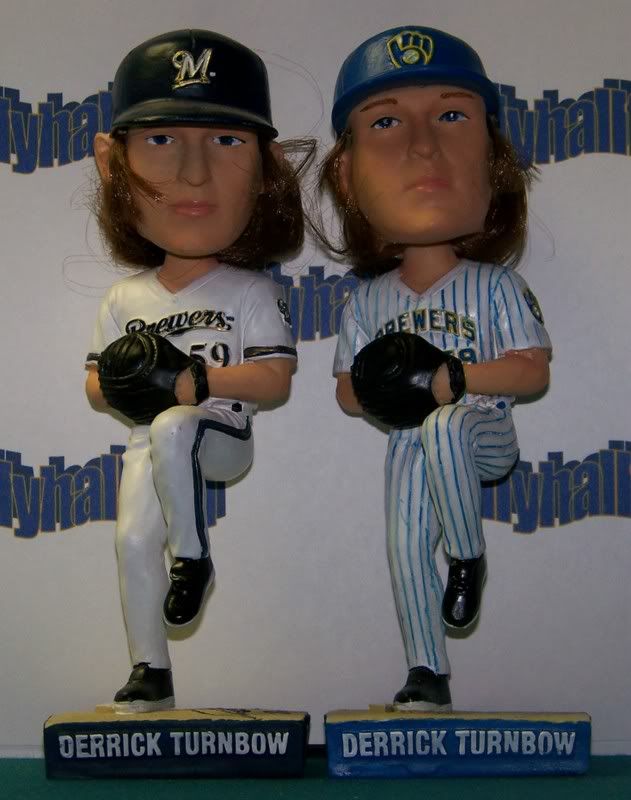
Instead, I will remember it because despite arriving to Milwaukee well in advance of the first pitch, we had underestimated the Dairy State’s fascination with Turnbow, their mulletted closer. That night was Derrick Turnbow bobblehead doll night, with his mane being immortalized with actual glued on hair. It was particularly ironic that he should come in to take the loss in a tie game in the top of the ninth inning, but as I noted, players often suffer bizarrely poor performances on bobblehead nights in their honor for no apparent reason. As Feiny facetiously pointed out, “Babe Ruth died on his bobblehead doll day.”

The demand for this particular promotion was so strong that we struggled to find parking anywhere near the stadium and eventually put our car next to Deek’s in a vacant lot next to a McDonald’s which sat down the road from the stadium. The five of us didn’t enter the turnstiles until the sixth inning.

I probably should have assumed ahead of time that the entire state of Wisconsin gets in gear when there are limited edition free nodding statues in the mix. The stadium’s attendance that night was well in excess of its seated capacity, as the up-and-coming Brewers – they would reach the postseason two years later for the first time since 1982 – proved a strong draw. Doubly so on promotional nights. I would leave the park satisfied considering the Mets won the day, but I would be lying if I claimed to be calm and relaxed throughout the entire course of trying to find a parking spot. This irritation was only worsened when I found that Deek and Feiny decided, despite the game already being five innings old, to actually go into McDonald’s after parking. Fortunately, they were so hungry that they managed to scarf down their food as we walked to the building, picked up our tickets and entered a mere 2/3 of the way through the game.

But we did get our bobblehead dolls – and in the limited edition throwback uniform to boot.

Zach in the meantime felt the need to overcome whatever stress he was recently enduring by drinking a lot of beer. And quickly. Two innings after we showed up it was very clear I was going to be driving home as Silka was in no condition to do so himself. Considering we only got to watch three innings of the game, the amount of time for him to sober up was practically nil. Zach had also convinced us to divert from our original plan of spending the night in the party town of Madison because Deek and Feiny broke it to him that at this point of early May, most University of Wisconsin students were studying for finals or home after finishing them.

The inebriated Silka convinced me we must drive back to Evanston for a party that wound up never happening, and after he told a number of Mets fans at the stadium that he was from Syosset, New York instead of his actual hometown of Toledo, Ohio, Zach quickly passed out in the back of his SUV as I guided it back to Evanston. Halfway through the ride Zach woke up and told me we absolutely had to pull off at the next hotel so he could use the bathroom. This required going through an unmanned tollbooth, which we shockingly didn’t have enough change on us to pay for. As Zach threw pennies in the bucket and insisted we go through anyway, I stopped at a hotel where he calmly went inside to ask the front desk where the rest room was.

A few minutes later Silka emerged. Rather than walk to the car he casually strolled around the side of the building and relieved himself behind a dumpster. Evidently they wouldn’t let him use the bathroom inside. It seems strange that my strongest memory from visiting Miller Park might be seeing my roommate get turned away from a public rest room, but knowing the zaniness of that entire night, it sort of makes sense.

And knowing what shape he was in, well, I can’t say I blame them.

Tuesday, January 26, 2010

Goodbye College, Hello Cleveland

Originally written January 14, 2010

The last few days of college are a bizarre time, particularly for those of us who are without a job or any real idea of where they’re going in life. I had no job lined up and prospects were pretty scarce. I applied to 100 or so over the final few weeks as I wrote my last papers and began packing up. Most of the calls had come from news clipping organizations I had little interest in working for that would have required me to be in the office by 4:30 a.m. on some days. Beyond that the ways to find a job writing in sports in New York without having ever actually interned for a major newspaper seemed few and far between.

I believe it was my stepmother, Audrey, who asked me what I wanted to do for a living the day I graduated. The latter of my two commencements ended at Welsh-Ryan Arena in Evanston and as we went through the obligatory picture taking session by Ryan Field, Northwestern’s football stadium, she posed the question.

“I want to watch baseball,” I said. “For money.”

It was always good for a laugh, and yet I wasn’t particularly sure where I’d go. I had tried my best to balance mailing out resumes, packing my things, and squeezing in all the necessary goodbyes and drunken memories that the final two weeks after finals provide you with. Those goodbyes are tricky. You’re not sure which of the people you’ve spent the last four years with you’re going to still be in contact with and who you need to say goodbye to for good.

And there are some.

But you can’t afford to be too schmaltzy or else your life will never get where it’s going. You just have to take it in stride. And it ain’t easy. But you manage.


I tried not to let it on as I packed my room and scrambled to sell furniture that I wouldn’t be taking back east, but jobless me was a nervous wreck and what laid ahead was a mystery. Fortunately, I had one carrot to distract me from the uncertainty before my mother and I caravanned two cars full of four years back to New Jersey.

For me, I generally would drive from my childhood home in Millburn to Evanston in one shot if I were by myself – all twelve hours of it. My mother couldn’t stand to sit in the car that long in one day and whenever I made the trip with her, we would break it in two, often staying at the same Hampton Inn in Milan, Ohio that had a rather pungent textile factory across the highway from it. That wasn’t always bad, as we would usually eat at the same restaurant, a BBQ grill joint called the Roadhouse, which was the type of place that served you your rack of baby back ribs with a side of 5 oz. grilled sirloin.

But for the trip home my mother had suggested that we instead stay in a nice hotel in Cleveland and treat ourselves. The actual hotel itself that we stayed in was of little interest or import to me, but I did notice one thing that was.

The Indians were in town.

That sealed the deal. When I originally asked my mother if the Indians were in town she told me she had already checked and that they were not playing the Mets. Of course, given that they play in two different leagues, the chances that the Mets would be there that week were scant anyway, but Cleveland was playing Philadelphia. At the very least I could root against the rival Phils. I decided to be the generous one and buy the tickets – after all, my parents had just paid for four years at a private college, I could give my mom a break – and I found two seats in row GG not far behind home plate for the Wednesday evening tilt on June 20, 2007.

And the seats came out to a mere $50 each. I love being impressed by ticket prices that aren’t in New York.

Of course, before the game came there was still the nasty business of graduating, writing my final papers, doing my drinking, saying my goodbyes, packing for home and selling my furniture. The furniture would be the most immediately impactful as I slept on my own bed one night before selling it, then slept on the bed my roommate had left before selling that, and then spent the last night sleeping on our disgusting couch.

The abruptness of the transition is confusing if for no other reason than that you’re not always sure how sentimental to get. Luisa had come over to give me company while I packed my final things and when she left nonchalantly said, “Well, it was fun going to college with you.” It seems simple, but sometimes you aren’t sure how serious to take these things, particularly since in the case of Luisa, we have kept close contact since graduating and college no longer appears to be the basis of our friendship so much as one chapter of it.

This is the case with a number of my close friends, but not so much with others. Knowing who will and won’t stay a part of your life is probably the most uncertain and difficult aspect of transitioning to the real world. Perhaps that's one of the reasons I'm doing this: To have an excuse to go around the country and keep in touch with all of them.

Still, at the time I was far more preoccupied with packing and getting on the road quickly on the 20th. The game itself was the night that we were leaving Evanston, which meant we’d have to make a quick exit to ensure we made it to Cleveland in time for the 7 o’clock start. This would be delayed by, as so often happens between children and their mothers at moments of heightened stress, a fight. In this case it revolved around a parking ticket my mother had gotten while we were loading up the cars that morning and my juvenile insistence that she simply ignore it so we could hit the road.

With the city backlog, my logic went, they’d never know the difference.

This, of course, did not sit well with my mother who made a point to go to the town municipal center and pay the ticket. Considering town hall was next to my apartment building, this wasn’t too big of a diversion.

After getting on the road, cooler heads began to prevail and we left one car behind the other on Lake Shore Drive, where I got my last looks at the city I had called home for four years. As I teetered between lead-footed and sentimental we eventually found our way onto I-80 and, with 90 minutes or so to spare, pulled into the Hilton Garden Inn in Cleveland.

My mother and I checked in and headed to the stadium just a few blocks away. Jacobs Field, or the Jake as it is colloquially known, is often considered one of the best parks in the Majors. This doesn’t come from any sort of trendsetting architecture. The modern trend of faux-retro parks still pulls its impetus from Camden Yards, which beat the Jake to opening day by a few years.

But indeed the intimacy and sight lines are among the best in baseball. To me, however, the most striking architectural feature is outside the stadium. The building’s structure features visible steel beams all around its exterior that give the appearance of an exoskeleton holding the stands up. What was most fascinating to me, however, is that the skeleton and its older style stadium lights are painted a bright white, making them stand out and giving the building an individualized and unique appearance that straddles the line between antiquated and futuristic.

The inside has a few features that might make it seem noteworthy, but nothing overwhelms anything else – with, perhaps, the notable exception of the 149-foot long video screen in left field. At the time it became my favorite park in the Majors. I can’t begin to imagine how much more pleasant it is to watch a game there than it was to do so in the Indians’ former home, the monstrous Cleveland Municipal Stadium, which housed 74,438 fans as opposed to the relatively cozy 43,515-seat capacity of the Jake.

I decided, as I often do, to take a stroll around the park and view it from different angles and see what it has to offer. As I continued my walk I happened upon Heritage Park, a circular museum dedicated to the Indians’ hall of famers and major moments that resides behind the batters eye in center field. Apparently it had just opened that year, but regardless, I hadn’t seen a hall of fame section that was quite so aesthetically pleasing in its subtle appearance and seamlessly weaved into the style of the ballpark. As I’ve visited more parks that have added their own hall of fame sections, I’ve enjoyed seeing the different orientations, but this one teaches you about the club’s history while still maintaining its presence as part of a stadium.

And speaking of being part of a stadium, the outfield concourse at Jacobs Field features a beer garden. Yes, these are common now, but this was the first time I had spotted it, or perhaps as a 21-year-old this was the first time I took note. I don’t much like drinking at ball games. If you have too much the whole experience moves too quickly and you lose track of what’s happening on the field. In the case of baseball, I understand this is preferable for some people but I’m far more concerned with seeing the tension that develops between the pitcher and the batter, and having five too many beers in me makes that infinitely more difficult to keep track of. Regardless, I suppose having the open air beer garden is necessary considering Jacobs Field was paid for by a 15-year sin tax on cigarettes and alcohol.

I will say this, though. The fans at the beer garden certainly looked like they were having fun. In the end that, I suppose, is the key to the experience.

And speaking of beer, as I walked back to my seat I passed by a stand that was selling Leinenkugel’s Sunset Wheat on tap. Sunset Wheat, as any of my close friends could tell you, is my favorite beer on the planet. It’s like candy. The big problem with this lies in the fact that Leinenkugel’s, based in Chippewa Falls, Wisconsin, hadn’t spread much out east. In fact, I had never seen it east of Chicago in my lifetime, to the point that I had made sure to buy a six pack of it before driving back to New Jersey much like I had always made sure to bring a healthy supply of Yeungling back to Evanston.

I don’t really buy beer at baseball games, both because it distracts me and because, usually, it’s outrageously expensive. I don’t need to spend $9.75 on a Miller Lite. But with the prospects of never seeing Sunset Wheat when I returned to the east coast staring me in the face, I bit the bullet – it was only seven dollars – and bought myself a beer to take back to my seat.

Ironically, I would see a six pack of it at the Kings Supermarket in Short Hills, New Jersey a week later. Leinie’s, evidently, had chosen to expand just in time.

The park was more than 50% full that night, but I was still surprised with the turnout after being accustomed to always seeing a full house on TV. In fact, Cleveland sold out the first 455 games at the Jake, a Major League record at the time, which is commemorated with “455” being among the retired numbers that hang against the brick walls in the right field portion of the upper deck.

Granted it was a week night, but the night I was there, the official attendance was a mere 53.7% of capacity at 24,278. For me, however, the average crowd didn’t take away from the game, which, for its first 5 ½ innings was a rather taut affair. Cleveland and Philadelphia had been tied, 2-2, leading up to the sixth inning, when the Phillies took a 4-2 lead courtesy of a two-run homer by Rod Barajas. The Indians responded in the bottom half of the inning by scoring eight runs and having eight consecutive batters reach base to put the game away. C.C. Sabathia pitched six innings to earn the win, becoming the first Indian to get 10 wins in seven consecutive seasons since Addie Joss turned the trick for Cleveland a century earlier from 1902-1909.

As a rule I will almost never leave a game early, particularly if I’m in a new stadium. My diligence paid off in the top of the ninth inning when Shane Victorino came to bat for Philadelphia with two outs. Victorino had two strikes on him when he fouled off a high pitch that banged off the façade of the second deck and dropped down directly in front of my mother and I.

I never will understand why we scrape so violently and irrationally for a dinged up piece of cowhide, but there I was diving to the ground with my sole competition a glasses bedecked woman who appeared to be in her mid-30s. The woman may have been closer to the ball.

But I don’t care. I got it. It was mine. After two decades of watching baseball games and dozens of close calls, at long last, I had caught a foul ball.

The man sitting to my right asked if he could look at it, and perhaps I was too used to trusting everyone in the Midwest as I handed it over to him. Fortunately, he, too, was a trusting non-east coaster. He glanced at the black scuff mark left by Victorino’s bat, handed it back to me and, with a smile, said, “Congratulations.”

On the way out of the park my mother anxiously told me to stop staring at the ball as we walked back to our hotel for fear someone would steal it. Once we returned, I began telling the world, which seemed far less excited about it than I was, before finally getting some rest for the next day’s drive home.

24 hours later, I pulled into our driveway behind my mother, walked inside, and that was it.

College was over.

I remember the morning after my bar mitzvah dealing with the depression that comes after the passing of a major life event. I was older and more capable of handling it now, but this was far more daunting. I now had to find a way to move on. I had to find something to do.

My first post-college job interview was with an HR person at Time Inc, who was testing my worthiness to be employed at SI.com. I admit that I was unprepared. At the very least I should have gone to the website that morning to familiarize myself with it. Of course, that problem didn’t really prepare me for the woman’s first question:

“If an unexpected occurrence were to arise in the office, what contingency would you have prepared for that paradigm?”

I stumbled my way through some nonsense response that showed how unprepared I was and probably cost me the job immediately – I was ushered out of the office shortly afterwards – but what I wanted to say to her was, “You know people don’t talk like that in the real world, right?”

After killing time with my friend Matt for a few hours, I headed to Chelsea Market to interview at MLB.com for the position of a night shift web producer. The atmosphere was far more relaxed and much less formal, and the first thing I had to do was take a written test on baseball trivia. At the very least, even if I blew another interview, at least I’d have some fun.

Afterwards, I went home to continue my post college malaise as I tried to find direction and, most importantly, a source of income, uncertain of what the immediate future would bring.

Two nights later I got an e-mail from the night production manager at MLB.com. I would be watching baseball for money.

Friday, January 15, 2010

The Mecca of American League Baseball

Originally written June 15, 2009

It bothered me for quite some time that the Cubs were out of town on my first major college visiting trip. When we first had decided to take a jaunt to the Midwest, seeing a game at Wrigley Field, the legendary home of old National League baseball with its ancient grandstands and ivy-covered outfield walls was my biggest priority.

Those priorities had to be reordered after glancing at the schedule, but fortunately, a year later I would not be in a similar spot when my mother and I made a college tour in Boston. Yes, the point of the trip was, ostensibly, to look at universities like Tufts or Harvard – the latter of which I never seriously considered applying to – but for me the entire purpose of the drive to Beantown was to get out to Yawkey Way and make my first visit ever to Fenway Park.

My mother and I checked the schedule after planning our trip and found the Sawx would be hosting the highly mediocre Tampa Bay Devil Rays that week. In a building so rife with history and so low on capacity the seats were appropriately overpriced, but there are only so many opportunities an out-of-towner has to see a hallowed part of baseball history that is mostly unaltered from the day it opened. My mother bought tickets for the two of us as well as her high school boyfriend Richard, who now lived in Massachusetts, and two of his children. For the two of them it was a reunion. For me it was a religious pilgrimage.

We arrived well in advance of our guests and, as I always do when given the opportunity, I stuck along the baseline in the outfield during batting practice in hopes of snagging a baseball. That we, as rational, thinking, complicated psychological creatures go so gaga and go to such desperate lengths to grab a piece of cow hide that is easily purchased at a sporting goods store is always something of a mystery to me, but as I have spent countless hours attempting fruitlessly to snag one, I am in no place to criticize.

On this particular day I came as close to finally bringing a ball home as I ever had before when former light-hitting Mets utility infielder Jason Tyner stepped into the cage for some BP. While I remember Tyner because I enjoyed his scrappy play and quick start when he came up with the Mets, I’m fairly certain that the only people who remember that Jason Tyner ever played Major League Baseball are me, Tyner and my friend Adam Litterman, who could never grasp why his beloved Twins batted Tyner at DH when he had no discernible power stroke whatsoever.

As I waited eagerly and at attention down the leftfield line, Tyner hit a hard ground ball into foul territory and right towards where I had plotted myself against the wall. Sensing my moment for defensive greatness had come I leaned over the wall and put my hat on the ground in hopes of scooping it up as it rolled in. Instead, the ball zipped into my hat, rimmed out and rolled to the unattended nether regions of left field.

While this wasn’t as psychologically damaging as when a middle aged woman pushed me to the ground so she could snag a foul ball I was chasing after at a New Jersey Cardinals game when I was ten years old, I was nonetheless disappointed.

One could possibly assume this was hubris after I had just defended my wearing a Mets hat at Fenway Park to a curmudgeonly usher who grumbled at me upon seeing my headwear.

“May I help you?” I asked, wondering what my offense was.

“A Mets hat?”

“It’s not a Yankees hat.”

“It’s not much better.”

“I was one in 1986. Don’t blame me. Blame Buckner.”

This was the point at which I walked away believing I had cleverly one-upped the Fenway employee. It wasn’t until repeated viewings of Game 6 of the 1986 World Series had shown me I was being a bit presumptuous. While Bill Buckner undeniably bore most of the brunt of Boston’s anguish and outrage after the Red Sox collapsed in Game 6, any astute and knowledgeable student of the game would know that clearly relievers Bob Stanley and Calvin Schiraldi are truly to blame for the Sox squandering their would-be first title since 1918.

While Boston would finally shake the Curse of the Bambino two years later, in absolutely stunning fashion, no less, I became aware that day, April 26, 2002, that my mother was unfamiliar with the Red Sox plight. One of the nice features of Fenway is all of its pennants are posted on the center of the main grandstand behind home plate. As I explained to my mother which ones indicated mere American League titles and which represented World Series Championships, she pieced the math together and realized that Boston hadn’t celebrated a World Champion in baseball in, at that point, 84 years.

I proceeded to explain to her in detail the Curse of the Great Bambino with special mentions to Babe Ruth, Harry Frazee, Bill Buckner, Mookie Wilson and No No, Nanette. This was a profound surprise to my mother who had no clue of any Beantown misery. Of course, by the next time I visited Fenway Park, in May of 2009, Boston’s fortune’s had changed dramatically. The Red Sox had won two championships in the previous five years and were consistently one of the best teams in baseball.

It’s a good thing I made that second trip as I remember a stunningly small amount about the game and the stadium from my first visit. I can probably chalk most of this up to spending most of the night attempting to flirt with my mother’s high school boyfriend’s daughter who had attended the game with us. This was, clearly, an unsuccessful and, given the ties between our parents, an extremely awkward venture, but as an awkward 16-year-old I knew naught for propriety or smooth talk with the ladies. In fact, in the near decade since that game I’m fairly certain that's still the case.

Any time I managed to actually win one over – and it happens once in a while – is a tremendous stroke of luck.

My second visit to Fenway Park very nearly failed to get off the ground, as I had been planning to attend the Mets’ first trip to Boston in three years with my good friend Luisa. Luisa was the first good friend I met in college, as we were grouped together on an outdoor wilderness trip before orientation Freshman year. Ups and downs persist as they do in all relationships, but she, a Bostonian and I, a New Yorker, have relied on our east coast elitism to forge a strong bond with one another.

When I first took note of the Mets’ 2009 schedule I sent Luisa an e-mail with the following words:

“Mets. Sox. May 22-24. Fenway Park. We are fucking going. Period.”

Perhaps my language was a bit brash, but Squeeze, as she was sometimes called, never shied away from profanity and so with months to go before the first pitch, the plan was on. After weeks of scouring auctions on eBay, I finally happened upon two standing room tickets for the series opener on Friday, May 22nd. Unfortunately I was unable to get more than the one day off from work, so my whirlwind trip to Beantown would last a total of 17 hours.

I could generally live with that, but I was unaware that the fun was just beginning. For starters, my bus driver arrived 45 minutes late and announced that he was originally expected to drive a bus to Washington, D.C., but our driver had somehow disappeared.

Into thin air.

I had made the bus reservation fairly early to budget for such a mishap, but one can never anticipate a truck carrying gasoline that explodes in the middle of I-95 and completely shuts down traffic in both directions as a result. That seems like a difficult contingency to prepare for. And so, my bus remained motionless for more than an hour in southern Connecticut as I fretted about my best laid plans running dramatically astray and considered that my hopes of arriving early for batting practice would be reduced to praying I would actually make it for the first pitch. Fortunately, I wasn't the only person on the bus in this position. The man across the aisle from me heard me tell someone I was concerned about making it to the park on time and he turned to me and informed me that no matter what, we were making that game.

I was intrigued to see what plan he had ready for that, but once we passed the completely burned out 18-wheeler traffic picked up. In the end a bus originally scheduled to arrive at 2:15 p.m. finally pulled into Gate 21 at Boston’s South Station around 5:45. I sprinted to the nearest T station, headed to Luisa’s apartment in Back Bay, dropped off my bags and off we were. Luisa was sporting a Sox jersey with her last name on it, which her mother had been presented with by the team at an event once. Luisa asked me if it was lame of her to wear her own name on her jersey, and I told her not to be too concerned by it as I turned my back to lead her out the door and reveal “KALAN” embroidered across my back.

She was elated to not be the only one.

Fenway is, as a co-worker of mine put it, Disneyland for adults. The stadium is so ancient and yet rich with quirks, character and history that placing it all into context in your mind is merely impossible. More than rich with history however, is how rich with fun the building is. Rather than take your tickets at the gate, tickets are required just to get on Yawkey Way behind the stadium, enclosing the street so it can become a large drunken cookout as Red Sox Nation starts a veritable celebration that something greater than any of them is about to happen – a Red Sox game at Fenway Park, the historic mecca of the American League.

Like so many newer stadiums, the outside walls are a rich, red brick face, but these bricks were not thrown in to recreate some architecturally fashionable retro kitsch. These are the bricks that held brand new Fenway Park when it opened its doors in 1912. These are the bricks that housed Carlton Fisk’s waved homer off the foul pole in 1975, Bucky Dent’s back-breaking homer in 1978 and the spark for the Sox’ great rally in the 2004 ALCS. This was home to Johnny Pesky, Dom DiMaggio, Carl Yazstremski, Luis Tiant and perhaps the greatest pure hitter of all time, the Splendid Splinter, Ted Williams.

There is immeasurable history in those walls, and unlike Yankee Stadium, which has seen more than its fair share of history and triumph, Fenway – save for a few alterations – appears the same today as it did then. When you stand within those walls, you feel it. Seeing in person the building you’ve seen on TV a number of times, but never quite grasped until you set foot there is a wild experience. The gigantic John Hancock sign, the far-back stretching bleachers, the short right field wall, the construction beams in the grand stand, Pesky’s Pole and, of course, the Green Monster all pop at you as you walk into the field level and make you feel like you’re somewhere special.

If you’re lucky, like Luisa, you get to experience this every time you go to a baseball game. Much as I adored Shea Stadium and enjoy Citi Field, it is laughable to believe they are comparable to coming here. And given that I rarely have the opportunity to find myself there, and that I had standing room tickets, I was determined to move my way down and get as close a look at the field as I could.

Luisa had clearly never been taught by her father the ancient art of “moving down”. She was not practiced at the old tradition of usurping more valuable seats that you would never in your right mind actually pay for. This was an education for her. Upon walking in, we had already missed batting practice, but the ushers were few and far between, and so we walked about freely needing only to find a pair of seats no one would show up for. Our first stab was in the tenth row behind the on-deck circle, but those seats, we soon found, were spoken for, as were the pair five rows in front that we tried next.

Luisa was anxious we might get in trouble, but I told her to give me one last shot, and so it was that we plopped down some 20 rows behind the first base on deck circle as the game was beginning. The seats had not yet filled in around us and late arriving fans were still coming in through the first three innings. Eventually, the entire section filled to capacity – with the exception of the two seats we had taken.

With the only drawback being a particularly obnoxious Mets fan who sat behind us and yelled brazenly throughout the first several innings – and perhaps Boston’s tradition of singing Neil Diamond’s “Sweet Caroline” every game – we had spectacular seats to enjoy, and, at least for me, a spectacular game. Mets ace Johan Santana was on the hill and delivered a dominant performance as the Mets pulled off a 5-3 win in hostile Fenway. It wasn’t as hostile as normal of course, hundreds of Mets fans made the trip, all of them giving me a vote of confidence when I passed them on the streets of Back Bay afterwards. While the park was divided, we all understood, clearly, that our divisions did not run as deep as our caps and jerseys might have implied.

After all, we all hated the Yankees.

After the game, Luisa and I walked around Fenway, caught some drinks and ate a dessert that was far too large for the two of us, and toured her neighborhood where she gleefully pointed out the palatial manse of the Patriots’ Tom Brady. I will never stop being surprised by how early Boston shuts down, but it didnt' matter as a long day had worn me out and I had an early bus to catch the next morning so I could make it to the office in time. The trip was rushed and hectic to be sure, but few are the opportunities to see a place like Fenway. For all things considered, sightlines, amenities, etc, it is not the best stadium in baseball. Of the places I have been to, I will still defer to Jacobs Field for that designation.

But watching a game at Fenway is an experience unlike any other. I spent less than 24 hours in Boston for the purpose of a baseball game, which, to some, surely, is insanity. But after two games in Fenway Park, I have come to the conclusion that while few places warrant that type of frenzied dedication, if I had to select just one, this would be it.